 Learn Quranic Arabic
To learn Arabic to read the Quran, start with the 28 Arabic letters and their shapes, then learn the vowel marks (harakat), practice joining letters with the Noorani Qaida, apply basic Tajweed rules, and move from single words to short surahs, ideally with a qualified teacher correcting your pronunciation from day one.
If you’re a non-Arab Muslim, a new revert, or someone who memorized a few surahs by ear but can’t read the Mushaf, this is a goal you can reach. You don’t need to become fluent in Arabic. You need a clear order of steps, short daily practice, and someone to catch your mistakes before they become habits.
So, how to learn Arabic to read Quran is to follow the steps in order and not skip ahead. Each stage below builds on the one before it, and each ends with a checkpoint that tells you when you’re ready to move on.
Step 1 – Set Your Goal and Choose Your Mushaf Script
Before you learn a single letter, two decisions will shape your entire journey, and most beginners skip both. They download an app, watch a few videos, and dive straight into the alphabet without asking themselves the most important question:
What exactly do I want to achieve? Do you want to read the Quran fluently from the Mushaf? Recite it beautifully with proper Tajweed? Understand the meaning of what you’re reading? Each goal calls for a slightly different path. Without a clear destination, it’s easy to wander between resources, lose motivation, and quietly give up within weeks.
The second decision is just as practical: which Mushaf script will you learn from? The two most common styles, the Madani and the Indo-Pak, carry the same Quran word for word. They do look different, though, in their lettering, vowel placement, and some of their symbols.
Learning from one and then switching to the other can feel like starting over. A simple rule makes this choice easy: choose the script used by your teacher, your local mosque, or the Mushaf you already have at home. Take a few minutes to set your goal and choose your script now, and every step that follows will be clearer, faster, and far more rewarding.
Step 2 – Master the 28 Arabic Letters and Their Forms
Every journey into the Quran starts with the same 28 letters. They’re the same ones a child in Cairo, a student in Jakarta, and a convert in London all learn first. Before you can read a single verse, these letters need to become as familiar to you as the letters of your own name.
The good news is that this is far more achievable than it looks. Many Arabic letters share the same basic shape and are told apart only by their dots. Look at ج, ح, and خ: one dot below, no dot, and one dot above. That’s the whole difference. Learn the shape once, then learn the dots, and suddenly three letters feel like one.
There’s one more layer that catches nearly every beginner off guard. Arabic letters change their appearance depending on where they sit in a word: alone, at the start, in the middle, or at the end.
The letter you recognize instantly on a flashcard can look like a stranger inside a real word from the Mushaf. That’s why this step goes beyond memorizing the alphabet.
You’ll learn each letter’s name, its sound, and every form it takes, so that when you open the Quran, you’ll recognize the letters wherever they appear. Master these 28 letters and their forms, and you’ll have built the foundation every other step depends on.
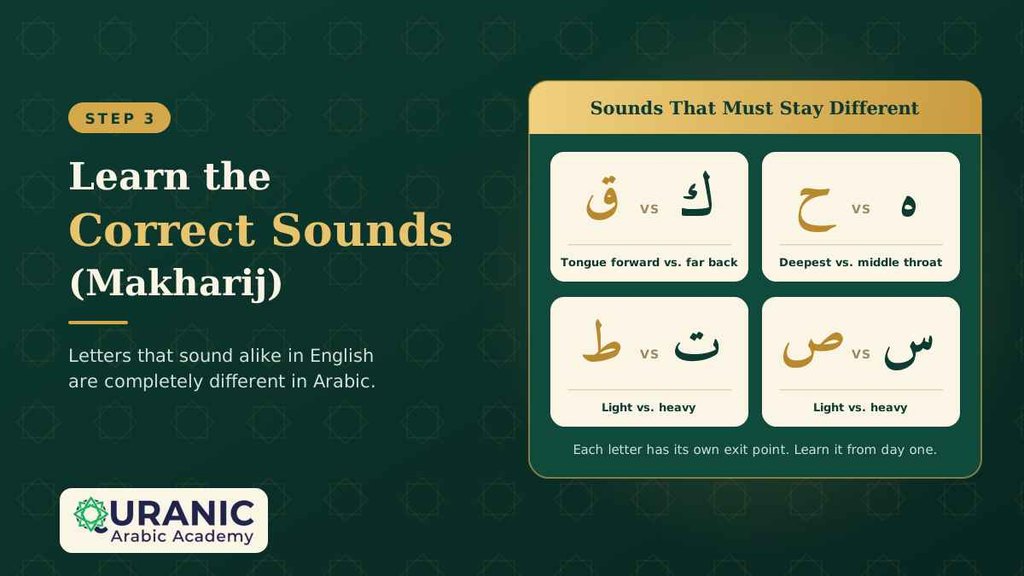
Step 3 – Learn the Correct Sounds (Makharij)
Here’s a fact that surprises many beginners: the Quran swears by the fig, wat-teen (وَٱلتِّينِ), and it also tells us that Allah created the first human from clay, teen (طِين). To an English ear, those two words can sound the same.
In Arabic, they begin with two completely different letters: a light ت made with the tip of the tongue, and a heavy ط that fills the whole mouth. Say one where you mean the other, and you haven’t just mispronounced a word. You’ve changed it into a different one.
That’s the power, and the responsibility, of the Makharij. Every Arabic letter has its own exact birthplace: deep in the throat, at the back or tip of the tongue, between the lips, or in the nasal passage. Many letters that English speakers hear as “the same sound,” like ه and ح, ك and ق, or س and ص, are actually produced in completely different places.
Your mouth is an instrument, and this step teaches you to play every note correctly. It may feel awkward at first to reach sounds you’ve never made before, but every hour spent here pays off for a lifetime. Learn the correct sounds now, before habits set in, and every verse you read afterward will carry the clarity, precision, and beauty the Quran deserves.
Step 4 – Learn the Vowel Marks (Harakat), Sukoon, and Long Vowels
Think of Arabic letters as the notes in a piece of music, and the vowel marks as the instructions that tell you how to play them. Without those instructions, you’d be left guessing: should this note be short or long? Open or closed? Should it flow into the next one or stop? In the Quran, those instructions are always there, printed above and below every letter. Once you learn to read them, you’ll never have to guess again.
And the stakes are real. Read قَتَلَ (qatala) and it means “he killed.” Stretch the first vowel into قَاتَلَ (qātala) and it becomes “he fought.” One extra beat on a single vowel changes the entire meaning. In this step, you’ll learn the three short vowels, the Harakat: Fatha for an “a” sound, Kasra for “i,” and Damma for “u.” Each one is held for a single beat.
Then you’ll learn the Sukoon, the small circle that tells you to stop the vowel and close the sound. Finally, you’ll meet the long vowels, formed with ا و ي, which stretch the sound to two beats. Together, these marks bring the silent skeleton of the letters to life. Master them, and you’ll move from recognizing letters to truly reading words.
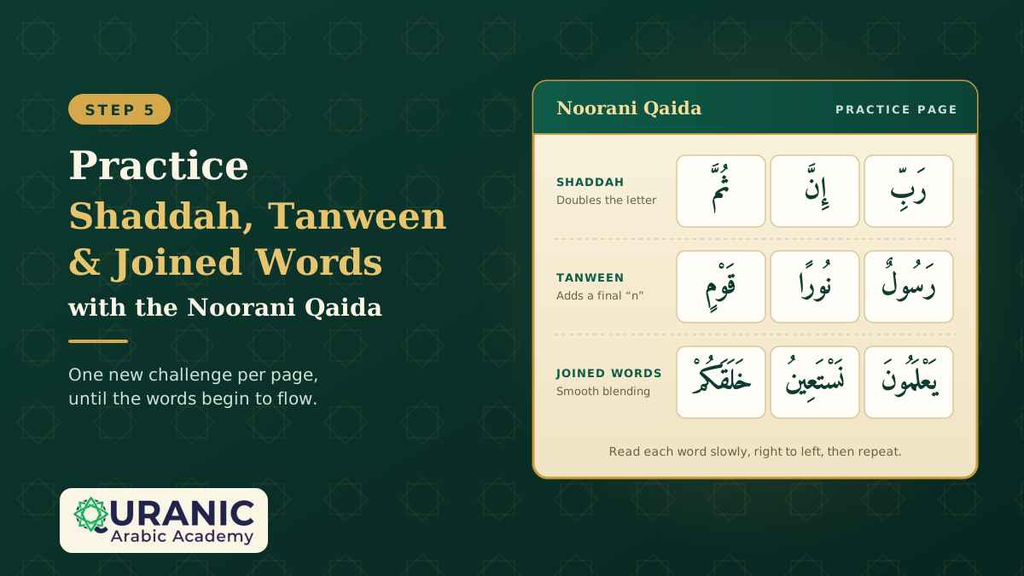
Step 5 – Practice Shaddah, Tanween, and Joined Words with the Noorani Qaida
By now you know the letters, their correct sounds, and the basic vowel marks. This is the stage where many self-taught learners hit a wall. Isolated letters feel easy, but the moment two letters merge under a Shaddah, a word ends with a double vowel, or several letters flow together into one long word, everything suddenly feels harder.
Your eyes know the pieces, but your tongue hasn’t yet learned to put them together smoothly. What you need now isn’t more theory. It’s structured, step-by-step practice.
That’s exactly what the Noorani Qaida was designed for. For generations, this small but powerful primer, originally compiled by Sheikh Noor Muhammad Ludhianvi, has helped millions of children and adults around the world move from single letters to fluent reading. Its lessons build in a careful order.
You practice the Shaddah, which doubles a letter’s sound, and Tanween, which adds a soft “n” to the end of a word. You also read joined letters and full words, many of them taken directly from the Quran.
Each page adds just one new challenge, so progress feels natural instead of overwhelming. Work through it patiently, ideally with a teacher listening, and you’ll find that words which once looked tangled begin to flow from your tongue with confidence.
Step 6 – Move From Words to Short Surahs
There’s a special moment every learner remembers. You’ve spent weeks on letters, sounds, vowel marks, and practice words, and then, for the first time, you read a complete surah from beginning to end. It isn’t a drill or an exercise from a workbook. It’s the actual words of Allah, flowing from your own tongue, verse after verse.
That moment changes everything. Learning stops feeling like study and starts feeling like worship, because this is what all the earlier steps were preparing you for.
This step is about making that leap carefully and confidently. Instead of jumping straight into long chapters, you’ll begin with the short surahs from Juz’ Amma, the final part of the Quran, where many surahs are only a few lines long. Surahs like Al-Ikhlas, Al-Falaq, and An-Nas give you complete, achievable goals.
You can practice every skill you’ve learned so far on real Quranic text without feeling overwhelmed. Many of these surahs are ones you already know by heart from your daily prayers, so your ears will guide your eyes as you read. Take them one at a time, read slowly, and have a teacher check your recitation.
You can read a short surah you haven’t memorized, without listening to it first and without mistakes. For a detailed method, see our guide to reading the Quran word by word.
Step 7 – Apply Basic Tajweed Rules
Have you ever noticed that a skilled recitation of the Quran sounds the same whether it comes from Cairo, Kuala Lumpur, or Chicago? The same gentle nasal hum, the same echoing bounce on certain letters, the same graceful stretch of the vowels. That isn’t a coincidence or a regional style.
It’s Tajweed, a precise set of rules preserved and passed down for over fourteen centuries, so the Quran is recited today the way it was recited by the Prophet ﷺ. Now that you can read short surahs, it’s time to make your recitation part of that unbroken tradition.
Many beginners hear the word “Tajweed” and imagine an overwhelming subject that takes years to master. The basics are far more approachable than they seem, though.
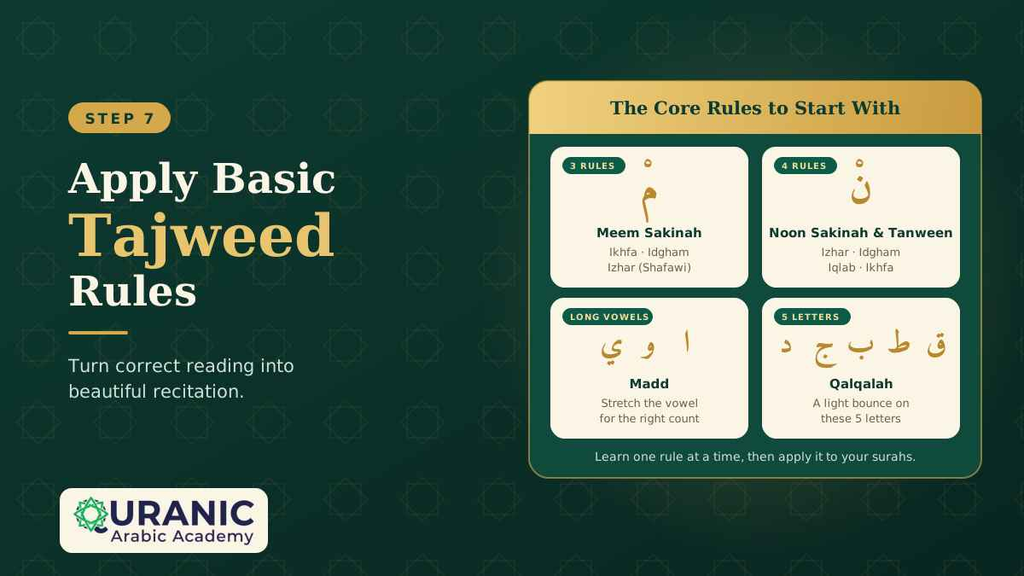
A large share of what you’ll hear on any page comes from just a few core rule groups. There are the four rules of Noon Sakinah and Tanween, which decide whether a sound is pronounced clearly, merged, changed, or hidden. Meem Sakinah has its own three rules. Qalqalah adds a light bounce to five letters (ق ط ب ج د), and the Madd rules tell you how long to stretch a vowel.
In this step, you’ll learn them one at a time and apply each one directly to the surahs you’re already reading. Rule by rule, your reading will turn into recitation, clear, correct, and beautiful to hear.
You can name and apply four or five core Tajweed rules while reading Juz Amma. To go further, read our guide to Tilawah, Tajweed, and Tarteel.
Step 8 – Start Understanding What You Read
You’ve reached a milestone that once felt impossible: you can open the Mushaf and read the words of Allah in Arabic. But there’s one more door waiting to be opened, and it may be the most rewarding of all. Imagine reciting Al-Fatiha in your prayer and knowing, word by word, what you’re saying to your Lord.
Imagine hearing a verse in Taraweeh and feeling its meaning reach your heart before the imam even finishes the line. Reading the Quran is a blessing. Understanding it as you read turns that blessing into a conversation.
Allah asks in the Quran:
﴿أَفَلَا يَتَدَبَّرُونَ الْقُرْآنَ أَمْ عَلَىٰ قُلُوبٍ أَقْفَالُهَا﴾
“Do they not reflect upon the Quran?” (Muhammad 47:24).
Reflection begins with understanding, and the journey there is shorter than most people think. The Quran repeats many of its core words again and again, so a relatively small set of frequent words, such as Allah, Rabb, qala, amanu, and ard, makes up a surprisingly large share of every page.
In this step, you’ll start building that vocabulary. You’ll learn the meanings of the surahs you already recite, notice common word patterns and roots, and connect each new word to the verses where it appears.
You don’t need to become an Arabic scholar overnight. Just begin with one word, one verse, and one surah at a time, and watch as the words you’ve learned to read slowly begin to speak to you.
You recognize repeated words in Al-Fatiha and your other prayer surahs. When you’re ready to go deeper, explore our Arabic courses for understanding the Quran or keep our Quranic Arabic dictionary guide close as you study.
Do You Have to Learn Arabic to Read the Quran?
Yes, to read and recite the Quran itself, you need to be able to read the Arabic script. To understand its message, you can start with a translation and Tafseer, but learning Quranic Arabic gives you direct access to the words Allah revealed.
The Quran was revealed in Arabic, and a translation is a human rendering of its meanings, not the Quran itself. That’s why reciting the Quran, whether in Tilawah or in Salah, means reading the Arabic text.
According to the majority of scholars, Surah Al-Fatiha in particular must be recited in Arabic during prayer. If you have a specific situation, such as being a new revert who is still learning, ask a qualified scholar for guidance.
The good news is that reading the Quran correctly doesn’t require fluency in the Arabic language. You need to recognize the letters, pronounce them accurately, and follow the vowel marks and recitation rules. Many Muslims around the world recite beautifully without being able to hold a conversation in Arabic.
What you should avoid is relying on transliteration (Arabic written in English letters). It can’t represent sounds like ع, ح, or ض, and it hides the difference between short and long vowels, which can change the meaning of a word.
| Your goal | Do you need Arabic? | What to learn |
|---|---|---|
| Recite the Quran | Yes, the Arabic script | Letters, harakat, Tajweed |
| Pray correctly | Yes, for Al-Fatiha and prayer phrases | Reading, plus the meanings of key prayer phrases |
| Understand the message | Helpful, not required to begin | Quranic vocabulary, grammar (Nahw and Sarf), Tafseer |
Most learners start with reading and then move toward understanding. If comprehension is your long-term goal, our guide on how to read and understand the Quran explains how the two skills connect, and our overview of Quranic Tafsir shows how scholars explain the meanings of the verses.
See It in Action:
Wondering what our interactive sessions look like? Click below to peek inside a live session and watch how our expert instructors make learning Quranic Arabic accessible and engaging.
Ready to Begin Your Quranic Journey?
Start learning with professional instructors through our structured curriculum.
Book Your Free TrialHow Long Does It Take to Learn Arabic to Read the Quran?
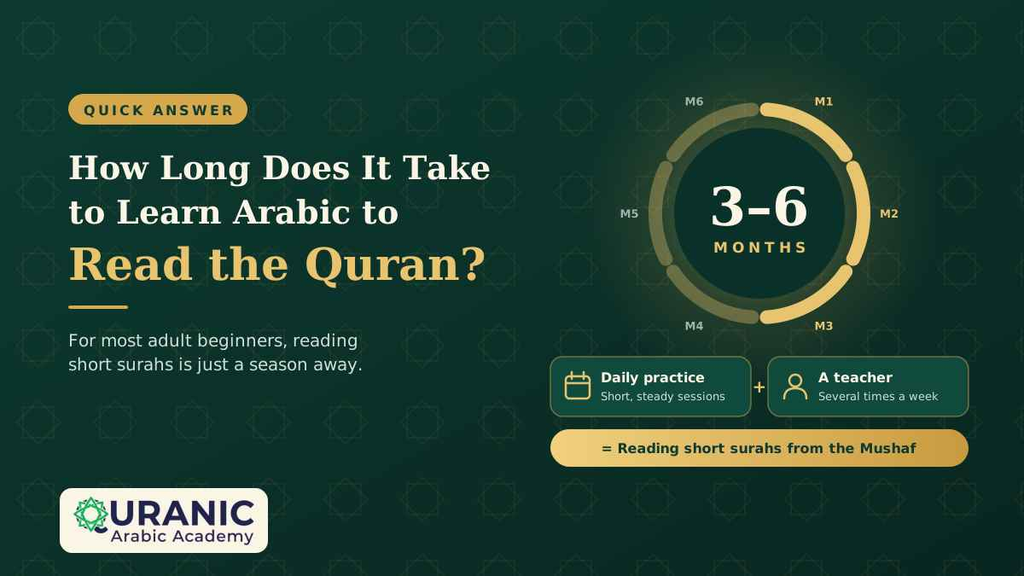
Most adult beginners who practice daily and meet a teacher several times a week can read short surahs from the Mushaf within about 3 to 6 months. Applying the core Tajweed rules confidently usually takes a few more months. The table below shows typical ranges for each stage.
| Stage | Typical time (3–5 lessons per week + daily practice) |
|---|---|
| Letters and their forms | 2–4 weeks |
| Makharij and harakat | 3–6 weeks |
| Completing the Noorani Qaida | 2–4 months |
| Reading short surahs accurately | 3–6 months from the start |
| Applying basic Tajweed with confidence | 6–12 months from the start |
These are averages, not deadlines. You’ll progress faster with short daily practice, one-on-one correction, and a single Mushaf script.
You’ll slow down if you study irregularly, skip the Qaida, or rely on transliteration. Adults often worry they’ve started too late, but that’s rarely true; our guide on learning to read the Quran as an adult explains why.
A Simple 20-Minute Daily Practice Plan
Twenty focused minutes a day will take you further than a two-hour session once a week. Short, regular practice keeps the letters and sounds fresh, and it’s easy to fit around work, family, and prayer times.
Split your 20 minutes into three parts. Spend the first 5 minutes reviewing yesterday’s letters, words, or Qaida lesson. Use the next 10 minutes for new material, reading slowly and out loud. Finish with 5 minutes of listening: play a qualified reciter and follow along in your Mushaf, then repeat each verse after them.
| Day | Focus |
|---|---|
| Days 1–5 | 20-minute daily loop (review, new material, listen and repeat) |
| Day 6 | Live lesson with your teacher for correction and new rules |
| Day 7 | Light review only: reread the week’s material once |
Once your reading is accurate, you can gradually build speed. Our guide on how to read the Quran faster without losing accuracy shows you how.
How to Learn Arabic to Read Quran Free
One of the most common reasons people delay learning to read the Quran isn’t time or ability. It’s money. Private tutors, paid courses, and premium apps can make it seem like reading the Quran is a privilege for those who can afford it. But the Quran was revealed as guidance for all of humanity, rich and poor alike.
And for over fourteen centuries, Muslims have taught it freely, out of love, in mosques, homes, and study circles around the world. The Prophet ﷺ said:
“خَيْرُكُمْ مَنْ تَعَلَّمَ الْقُرْآنَ وَعَلَّمَهُ”
“The best of you are those who learn the Quran and teach it” (Bukhari).
These resources are excellent for exposure and practice, especially in the early stages.
| Free resource | Best for | Limitation |
|---|---|---|
| Noorani Qaida (free PDF or printed copy) | Learning letters, harakat, and joined words in order | No one checks your pronunciation |
| Quran.com | Reading the Mushaf with audio and word-by-word meanings | Assumes you can already read the script |
| Quranic Arabic Corpus | Word-by-word grammar and roots for Step 8 | Too technical for absolute beginners |
| Recitation audio and video lessons | Training your ear and imitating Makharij | You can’t tell if your own imitation is right |
| Local mosque or community classes | Live teaching and community support | Fixed schedules; limited one-on-one time |
Free self-study has one real weakness: nothing free can listen to you and correct you in real time. Mistakes in sounds like ح or ض, or in vowel length, are hard to hear in your own voice, and once practiced for months they become habits that take longer to undo than to learn correctly.
If you prefer to study on your own, our guide on learning to read the Quran by yourself shows how to structure it. And if you’d like a teacher to assess your reading at no cost, you can book a free trial lesson with The Quranic Arabic Academy.
Learn Arabic to Read Quran Online Free vs. With a Qualified Tutor
Free online tools are a great supplement, but a qualified tutor is what turns practice into correct recitation. Here’s how the three main options compare when you want to learn Arabic to read Quran online free or with paid support.
| Free apps and videos | Group classes | One-on-one tutor | |
|---|---|---|---|
| Cost | Free | Low to moderate | Moderate |
| Pronunciation correction | None | Limited, shared among students | Live, every session |
| Structure | You build it yourself | Fixed syllabus | Tailored to your level |
| Schedule | Anytime | Fixed times | Flexible, around your routine |
| Pace | Depends on your discipline | Moves with the group | Moves with you |
The most effective approach for most learners combines both: free resources for daily practice, and a teacher who checks your reading every week. That combination gives you the low cost and flexibility of online free learning with the accuracy that only live correction can provide.
Experience Our Teaching Style
We believe in clarity and engagement. Watch these short highlights from our actual classes to see our teachers’ methodology and student interactions in real-time.
Ready to Begin Your Quranic Journey?
Start learning with professional instructors through our structured curriculum.
Book Your Free TrialLearn Arabic to Read the Quran Online With The Quranic Arabic Academy
The Quranic Arabic Academy is an online Quranic school that teaches the classical Arabic of the Quran, not conversational dialects or Modern Standard Arabic, to non-native speakers around the world. Every lesson has one purpose: helping you read the Mushaf correctly and, step by step, understand what you recite in your prayers.
Here’s how we solve the challenges covered in this guide:
- A clear path from the first letter to understanding. Our curriculum follows the same stages you’ve just read: the Noorani Qaida, then Tajweed, then Quranic grammar (Nahw and Sarf) and Tafseer. You always know what comes next.
- Ijazah-certified, native Arab tutors. Every instructor holds an Ijazah in Quranic recitation or a degree in Islamic studies. You can meet our Ijazah-certified teachers before you start.
- One-on-one live sessions with real-time Makharij correction. Your tutor watches and listens through video, correcting your articulation as you read, so mistakes are fixed before they become habits.
- Flexible schedules for every time zone. Students in the USA, UK, Canada, Europe, the Gulf, and Asia book lessons around work, family, and prayer times.
- Written feedback and progress tracking. After each session, you’ll know which rules you’ve mastered and what to practice next, just like the checkpoints in this guide.
Book Your Free Trial Lesson and let a qualified tutor assess your level and build your personal plan.
Our Arabic Courses
- Quranic Arabic Classes
- Quranic Arabic Course for Beginners
- Online Quranic Arabic Courses for Advanced Learners
- Quranic Arabic Grammar Course
- Arabic Courses for Understanding the Quran
Conclusion
Every great journey begins with a single step: how to learn Arabic to read Quran. The beginning may feel like an unfamiliar alphabet, a page of mysterious symbols, and sounds your tongue has never made. But step by step, those letters become sounds, those sounds become words, and those words become verses you can read with your own eyes and recite with your own voice.
Now you know how to learn Arabic to read Quran. Master the letters and their forms, then perfect the sounds and vowel marks so every word is pronounced correctly.
Complete the Noorani Qaida to build fluency with Shaddah, Tanween, and joined words, and then move from words to short surahs to practice on real Quranic text. Along the way, apply basic Tajweed to give your recitation its true beauty, and begin understanding what you read, so the Quran speaks to your heart and not just your tongue.
You don’t have to take this journey alone. A qualified teacher can correct your mistakes early, keep you motivated, and guide you from your first letter to your first full surah. Book your free trial lesson with The Quranic Arabic Academy today, and take your first step toward reading the words of Allah with confidence, clarity, and love.
FAQs
Can I learn to read the Quran without learning the whole Arabic language?
Yes. Reading the Quran correctly requires the Arabic script, the vowel marks, and Tajweed, not fluency in spoken Arabic. Many Muslims recite accurately without speaking Arabic. Understanding the meanings is a separate, gradual goal you can add later.
Can I learn Arabic to read the Quran on my own?
You can learn the letters and practice with free resources on your own, but it’s hard to correct your own pronunciation. The most reliable approach is daily self-study combined with a weekly session with a qualified teacher who can catch mistakes early.
Is it enough to read the Quran using transliteration?
No. Transliteration can’t represent several Arabic sounds or the difference between short and long vowels, so it often leads to recitation errors. It’s better to learn the Arabic script directly, even if progress feels slower at first.
Is there reward in reading the Quran without understanding it?
Yes. According to a hadith reported in Sunan al-Tirmidhi, every letter recited from the Quran earns a good deed multiplied tenfold. Another hadith in Sahih al-Bukhari and Sahih Muslim states that the one who recites with difficulty receives a double reward, so keep reading while you learn.
At what age can children start learning to read the Quran?
Many children begin with the Arabic letters and the Noorani Qaida around age 5 or 6, using short, playful lessons. Adults can start at any age. For tips on improving as you go, see our guide on how to improve your Quran recitation.
Related Articles
Learn Quranic Arabic




Leave a Reply