 Quran
Quran
Millions of Muslims across the USA, UK, Europe, Asia, and the Gulf open the Quran each day and ask how to read Quran for beginners.
They want to connect with its words, yet many beginners feel unsure where to begin. The journey is more structured than most expect.
The Quran is not read like ordinary Arabic text. It follows precise recitation rules that preserve every letter’s sound and meaning exactly as transmitted. Learning those rules in the right sequence makes everything else faster and clearer.
This guide gives you eight practical, ordered steps of how to read Quran for beginners based on how scholars and teachers have guided Quran learners for generations. Follow them consistently, and steady, measurable progress will follow from day one.
Each step below prepares you for the next. Skipping even one creates gaps that only surface later, usually when they are hardest to fix. Work through them in order, and your progress will remain consistent and sustainable.
1. Learn The Arabic Alphabet To Know How To Read Quran For Beginners
Knowing the Arabic letters is the single non-negotiable requirement before you open the Mushaf. Without full recognition, every step that follows becomes guesswork.
Arabic has 28 letters, each with four written forms depending on its position in a word. Complete familiarity with all four forms prevents the reading hesitation that slows most new learners significantly.
Learning the Quranic Arabic alphabet with its articulation points (makhraj) from the start locks in correct pronunciation immediately. Knowing exactly where each sound is produced, whether in the throat, tongue, or lips, prevents the most persistent early mispronunciations.
Start Your Quranic Arabic Foundation Today

2. Master the Diacritical Marks That Shape Every Letter Sound
Arabic letters carry their vowel information through small marks written above or below each letter. These marks, called harakat, determine the exact pronunciation of every syllable you read.
A learner who recognizes the letters but ignores the vowel marks will mispronounce nearly every word.
The marks change syllable sounds completely, and some also affect a word’s grammatical meaning. A full study of Quranic Arabic diacritics gives you the complete map before you attempt any connected verse.
Two specific mark categories cause the most early errors. Understanding both before you move to full-word reading eliminates an entire class of beginner mistakes from the start.
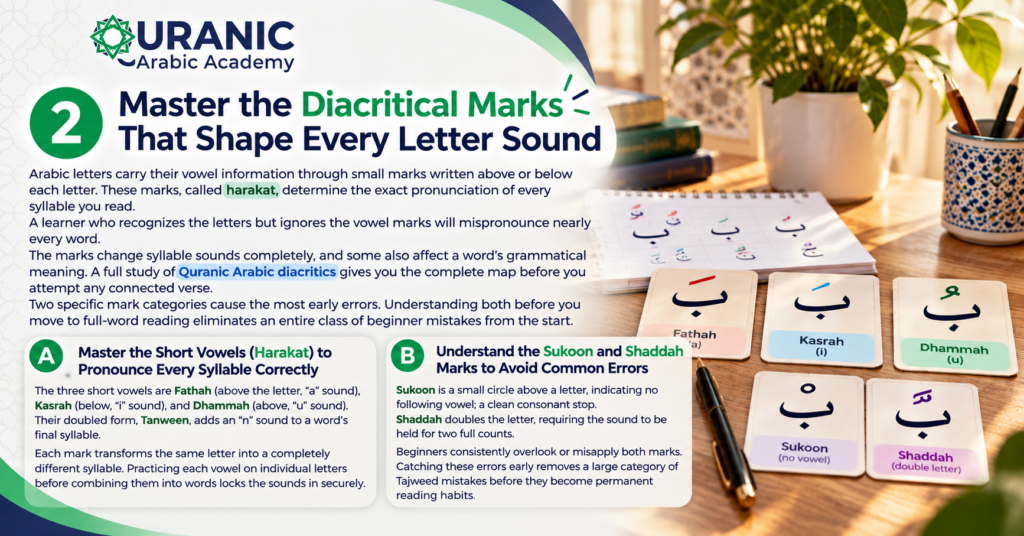
A. Master the Short Vowels (Harakat) to Pronounce Every Syllable Correctly
The three short vowels are Fathah (above the letter, “a” sound), Kasrah (below, “i” sound), and Dhammah (above, “u” sound). Their doubled form, Tanween, adds an “n” sound to a word’s final syllable.
Each mark transforms the same letter into a completely different syllable. Practicing each vowel on individual letters before combining them into words locks the sounds in securely.
B. Understand the Sukoon and Shaddah Marks to Avoid Common Errors
Sukoon is a small circle above a letter, indicating no following vowel; a clean consonant stop. Shaddah doubles the letter, requiring the sound to be held for two full counts.
Beginners consistently overlook or misapply both marks. Catching these errors early removes a large category of Tajweed mistakes before they become permanent reading habits.
See It in Action:
Wondering what our interactive sessions look like? Click below to peek inside a live session and watch how our expert instructors make learning Quranic Arabic accessible and engaging.
Ready to Begin Your Quranic Journey?
Start learning with professional instructors through our structured curriculum.
Book Your Free Trial3. Apply The Core Tajweed Rules From The Beginning Of Your Practice
Tajweed is the precise science governing how every letter, vowel, and pause in the Quran should be recited. The full scope of Quranic Tajweed rules preserves the exact pronunciation transmitted from the Prophet (peace be upon him) through an unbroken chain of teachers to this day.
Many beginners postpone Tajweed, believing it belongs to an advanced stage. In practice, foundational Tajweed rules apply from the very first verse you read. Starting with them immediately prevents errors from calcifying into permanent habits within weeks.
You do not need to study every Tajweed chapter at once. These three categories cover the rules you will encounter most frequently during your first months of reading.
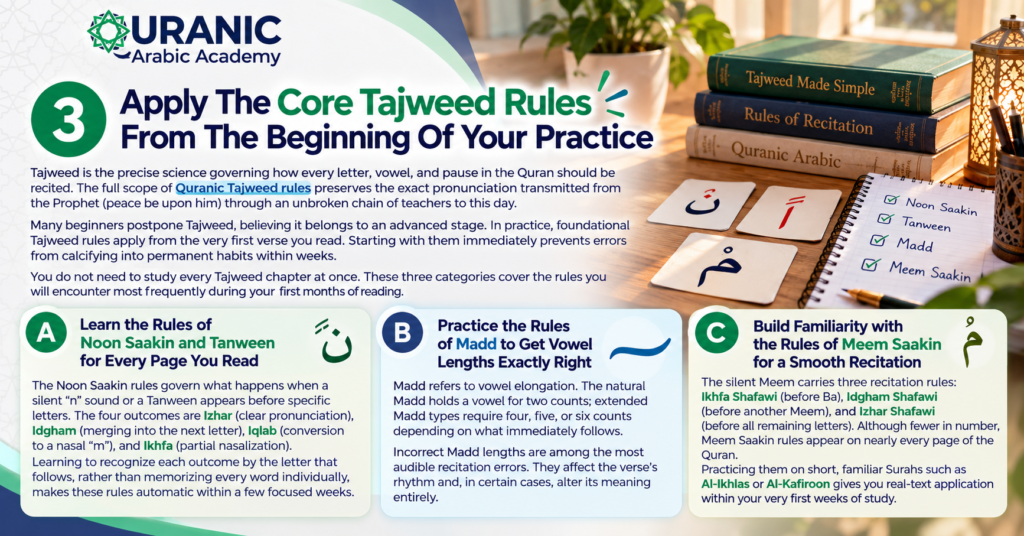
A. Learn the Rules of Noon Saakin and Tanween for Every Page You Read
The Noon Saakin rules govern what happens when a silent “n” sound or a Tanween appears before specific letters. The four outcomes are Izhar (clear pronunciation), Idgham (merging into the next letter), Iqlab (conversion to a nasal “m”), and Ikhfa (partial nasalization).
Learning to recognize each outcome by the letter that follows, rather than memorizing every word individually, makes these rules automatic within a few focused weeks.
B. Practice the Rules of Madd to Get Vowel Lengths Exactly Right
Madd refers to vowel elongation. The natural Madd holds a vowel for two counts; extended Madd types require four, five, or six counts depending on what immediately follows.
Incorrect Madd lengths are among the most audible recitation errors. They affect the verse’s rhythm and, in certain cases, alter its meaning entirely.
C. Build Familiarity with the Rules of Meem Saakin for a Smooth Recitation
The silent Meem carries three recitation rules: Ikhfa Shafawi (before Ba), Idgham Shafawi (before another Meem), and Izhar Shafawi (before all remaining letters). Although fewer in number, Meem Saakin rules appear on nearly every page of the Quran.
Practicing them on short, familiar Surahs such as Al-Ikhlas or Al-Kafiroon gives you real-text application within your very first weeks of study.
Read also: How To Read The Quran As A Non Muslim? An Experienced Roadmap
4. Decide Where to Start Reading the Quran Based on Your Goal
One of the most common questions new learners ask is: where should someone start reading the Quran? The answer depends on whether your priority is building early confidence or pursuing a complete, sequential recitation.
The Quran contains 114 Surahs arranged primarily by length, not by the order of revelation. There is no rule requiring beginners to open at Al-Baqarah and read forward. In practice, Juz Amma Quranic studies consistently deliver the best outcomes for new readers regardless of background.
Choosing your starting point wisely prevents the overwhelm that stops many learners in their very first week. The two most widely recommended options are outlined below.
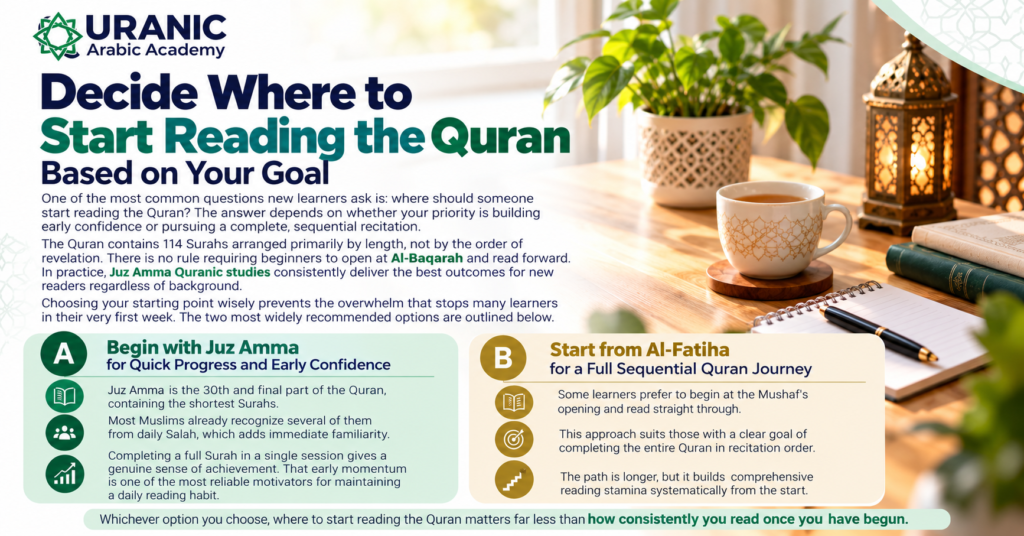
A. Begin with Juz Amma for Quick Progress and Early Confidence
Juz Amma is the 30th and final part of the Quran, containing the shortest Surahs. Most Muslims already recognize several of them from daily Salah, which adds immediate familiarity.
Completing a full Surah in a single session gives a genuine sense of achievement. That early momentum is one of the most reliable motivators for maintaining a daily reading habit.
B. Start from Al-Fatiha for a Full Sequential Quran Journey
Some learners prefer to begin at the Mushaf’s opening and read straight through. This approach suits those with a clear goal of completing the entire Quran in recitation order.
The path is longer, but it builds comprehensive reading stamina systematically from the start. Whichever option you choose, where to start reading the Quran matters far less than how consistently you read once you have begun.
Dicover What Are the Outcomes of Our Quranic Arabic Course in Australia?

5. Listen to Expert Reciters Every Day to Train Your Pronunciation Instincts
Your ear learns correct pronunciation before your mouth can reproduce it. Daily listening to expert reciters is one of the most consistently underused Quran reading basics available to every beginner at zero cost.
Understanding what is Quranic recitation at a deeper level reveals why listening matters so much. Sheikh Al-Husary, Sheikh Al-Minshawi, and Sheikh Sudais recite slowly and precisely, making every Tajweed rule clearly audible without musical distortion.
Listen to a verse before you practice it. This “listen first, then repeat” method trains your articulation through natural mimicry; the same instinctive process every child uses to acquire spoken language.
Master the Language of the Quran with Quranic Arabic Academy, first session free

6. Practice Under a Qualified Teacher for Corrections You Cannot Give Yourself
Self-study can carry you through the theory. It cannot, however, identify your specific pronunciation errors in real time. Without live, expert feedback, most learners develop reading mistakes that become habits within weeks.
The Prophet (peace be upon him) directed his companions to receive the Quran from specific, trusted teachers rather than learning it independently from a written text. That principle remains fully valid today, whether instruction is local or through online Quranic studies.
Quranic learning with peers in group settings also accelerates individual progress. Hearing classmates corrected for errors you share speeds up your own recognition and self-correction considerably.
Quranic Arabic Academy connects beginners worldwide with certified, Ijazah-holding teachers who specialize in Quran recitation and Tajweed.
All sessions are one-on-one, fully online, and available across all time zones for learners in the USA, UK, Canada, Australia, South Asia, Southeast Asia, and the Gulf.
Meet our certified Quranic Arabic teachers
7. Build A Daily Quran Reading Routine
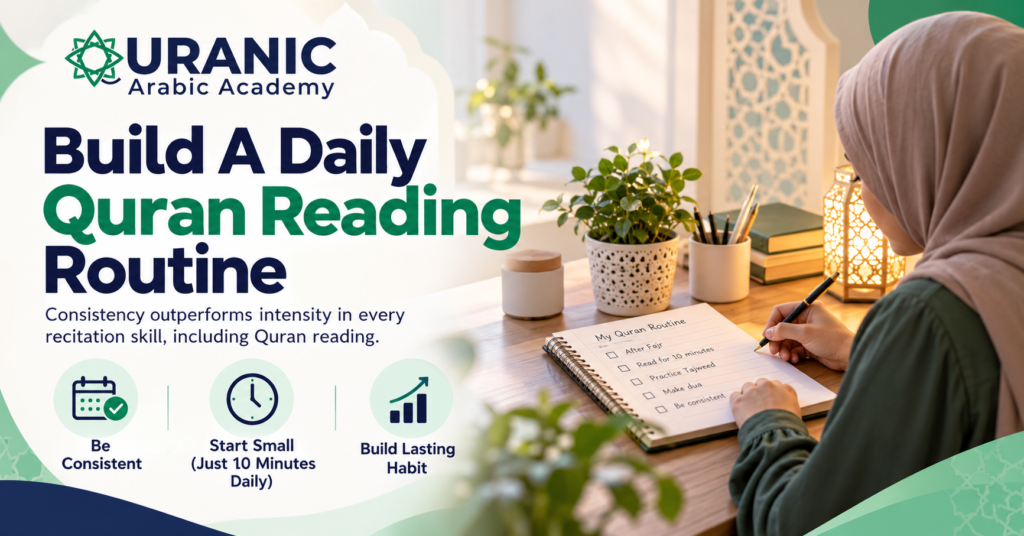
Consistency outperforms intensity in every recitation skill, including Quran reading. A learner who reads ten focused minutes daily builds far stronger foundations than one who reads for two hours once a week without structure.
Applying practical guidance on how to build a daily Quran routine before you begin ensures your reading habit survives beyond the first two weeks. Structure makes practice sustainable; intention alone rarely does.
The benefits of reading the Quran daily include sharper letter recognition, stronger Tajweed recall, and a growing spiritual connection that deepens over time.
Attach your reading session to an existing daily habit, such as after Fajr or before sleep, and it becomes nearly automatic within three weeks.
8. Use Digital Tools Wisely To Reinforce What Your Teacher Teaches
Digital tools are powerful supplements to a qualified teacher; they are not replacements for one. The right apps and resources extend your daily learning without adding scheduling pressure.
Exploring the best apps to learn Quranic Arabic shows how purpose-built tools combine audio recitation, Tajweed guidance, and vocabulary practice in one accessible platform.
A color-coded Tajweed Mushaf is especially effective for how to start reading Quran for beginners; it visually marks each rule on the page before you read it aloud.
Pair digital review sessions with recordings from a certified reciter. Use apps for reinforcement and daily review; keep your primary learning sessions with your qualified teacher as the anchor of your practice.
Quranic Arabic Academy designs its online courses specifically for complete beginners and non-Arabic speakers worldwide. Every student receives a personalized learning plan, direct corrections from certified instructors, and tracked progress from the very first session.
Experience Our Teaching Style:
We believe in clarity and engagement. Watch these short highlights from our actual classes to see our teachers’ methodology and student interactions in real-time.
Ready to Begin Your Quranic Journey?
Start learning with professional instructors through our structured curriculum.
Book Your Free TrialBegin Your Quran Journey Today Where Quranic Arabic Academy Supports Every Step
You do not need the perfect moment to begin. Every day spent practicing Quran reading basics brings you measurably closer to fluent, confident recitation.
Quranic Arabic Academy offers beginner-level Quran recitation courses taught by certified instructors holding authentic Ijazah chains.
Sessions are fully online, flexible, and available to learners across the USA, Canada, UK, Germany, France, Australia, South Asia, Southeast Asia, and the Gulf.
Check out our top courses to start learning Quranic Arabic today:
- Quranic Arabic Classes
- Online Quranic Arabic Courses for Advanced Learners
- Quranic Arabic Grammar Course
- Arabic Courses for Understanding the Quran
- Quranic Arabic Course for Kids
- Quranic Arabic Course UAE
- Quranic Arabic Course Germany
Book your free introductory class today and begin the eight-step journey with a teacher who knows exactly where new readers need the most support.
Conclusion
Learning how to read Quran for beginners is a well-mapped path with clear, achievable steps. Every accomplished reciter, regardless of where they live or when they started, followed the same foundational sequence.
Begin with the Arabic alphabet and diacritical marks. Decide where to start reading the Quran based on your goal, whether Juz Amma for early confidence or Al-Fatiha for a sequential journey.
Apply Tajweed rules from day one, listen to expert reciters daily, and work with a qualified teacher throughout.
The Quran reading basics in this guide are not shortcuts; they are the non-negotiable steps that every serious learner has always followed. Stay consistent with them, and fluent, rewarding recitation will come sooner than you expect.
Frequently Asked Questions
How Long Does It Take to Learn How to Read Quran for Beginners?
Most learners who practice 15 to 20 minutes daily reach functional reading fluency within three to six months. Progress depends heavily on consistency, the quality of teacher instruction, and how much daily listening practice accompanies the formal sessions.
Where Should Someone Start Reading the Quran with No Arabic Background?
Begin with Juz Amma, the 30th part of the Quran. Its Surahs are short and manageable, and most learners already know several from daily Salah. This entry point builds reading confidence and momentum faster than any other approach.
Can I Learn Quran Reading Basics Entirely on My Own?
You can study the theory independently, but pronunciation and Tajweed require live, qualified feedback to correct accurately. Without real-time correction, most self-study learners develop reading errors that grow progressively harder to reverse.
Can I Learn Quran Reading Basics Entirely on My Own?
You can study the theory independently, but pronunciation and Tajweed require live, qualified feedback to correct accurately. Without real-time correction, most self-study learners develop reading errors that grow progressively harder to reverse.
Do I Need to Understand Arabic to Learn How to Start Reading Quran for Beginners?
No. Reciting accurately and understanding meaning are two separate skills. Many fluent reciters across South Asia, Southeast Asia, and the West recite beautifully before they study Arabic grammar or translation in depth.
Is Tajweed Obligatory for Every Muslim Who Reads the Quran?
The practical application of Tajweed is obligatory for every Muslim to the extent of their ability. Its rules protect the Quranic sounds from alteration. Beginners should start with the most frequently occurring rules and build progressively from there.





Leave a Reply