 Quranic Grammar
The easiest way to read the Quran in Arabic is to learn it in layers: the 28 letters grouped by shape, the Harakat (vowel marks), connected letter forms, and simple word blending.
Then you apply these skills to short Surahs from Juz’ Amma while adding basic Tajweed. Fifteen to twenty minutes of daily practice, plus feedback from a qualified teacher, keeps you moving forward.
Many beginners look at a page of the Mushaf and assume it will take years to decode. It won’t. Arabic script is logical, and most letters follow a handful of patterns.
This guide shows you how to read Quran in Arabic step by step, with worked examples, a 30-day plan, and the shortcuts our tutors at The Quranic Arabic Academy use with first-time readers every day.
Step 1: Learn the Arabic Alphabet the Easy Way (by Shape Families)
Twenty-eight letters, all of them new and unfamiliar. For many beginners, the Arabic alphabet feels like the first wall standing between them and the Quran. Most people try to climb it the hard way, memorizing letters one by one in a long list, from Alif to Ya, hoping they’ll stick.
Then letters start blurring together, similar shapes get mixed up, and frustration sets in before the journey has really begun. But there’s a secret that makes this wall much smaller than it looks: many Arabic letters are related.
Look at ب, ت, and ث. They share the same basic shape. The only difference is the number and position of the dots: one below, two above, three above. The same pattern runs through the alphabet.
ج, ح, and خ are siblings, and so are د and ذ, ر and ز, and س and ش. Instead of learning 28 separate letters, you learn a handful of basic shapes and then the dots that tell family members apart.
| Shape family | Letters | How to tell them apart |
|---|---|---|
| The boat | ب ت ث | One dot below = b · two dots above = t · three dots above = th |
| The hook | ج ح خ | Dot inside = j · no dot = ḥ · dot above = kh |
| The small wedge | د ذ | No dot = d · one dot above = dh |
| The slide | ر ز | No dot = r · one dot above = z |
| The teeth | س ش | No dots = s · three dots above = sh |
| The loop | ص ض | No dot = ṣ · one dot above = ḍ |
| The upright loop | ط ظ | No dot = ṭ · one dot above = ẓ |
| The open mouth | ع غ | No dot = ʿ · one dot above = gh |
| The round head | ف ق | One dot above = f · two dots above = q |
The remaining letters (ا ك ل م ن ه و ي) each have their own shape. Notice that ن and ي look like the boat family at the start or middle of a word, so watch their dots closely.
Step 2: Train Your Makharij From Day One
In Arabic, one small slip of the tongue can change everything. Say قلب (qalb) with a deep, clear ق from the back of the throat, and you’ve said “heart.” When you’re reading the words of Allah, those differences matter. That’s why pronunciation isn’t something to fix later. It’s something to build right from the very first letter.
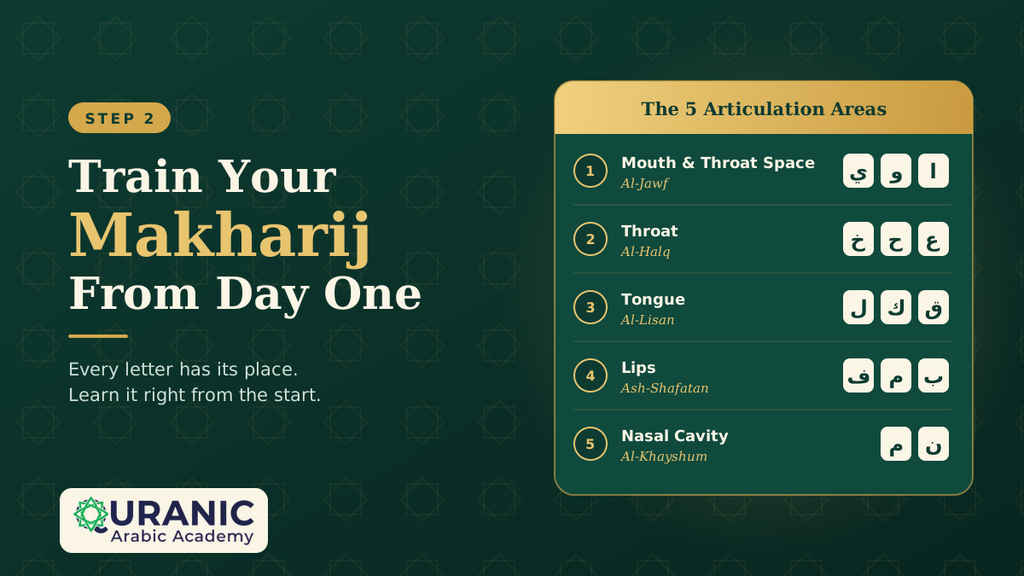
This is where the Makharij come in. Makharij are the articulation points, the exact places in your throat, tongue, lips, and nose where each Arabic letter is born.
Every letter has its own home, and learning where that home is turns guessing into precision. Many beginners rush past this step, eager to start reading words, only to discover months later that they’ve been pronouncing certain letters wrong the whole time.
Train your Makharij from day one, and every word you read afterward will be built on a solid foundation, clear, accurate, and true to how the Quran is meant to sound. Learn them in pairs so your ear catches the difference early:
| Light/familiar | Heavy/unfamiliar | What changes |
|---|---|---|
| ت (t, as in “tea”) | ط (ṭ) | Raise the back of the tongue for a fuller, heavier t |
| س (s, as in “see”) | ص (ṣ) | Same s, but heavy with the back of the tongue raised |
| د (d) | ض (ḍ) | Side of the tongue presses against the upper molars |
| ذ (th, as in “this”) | ظ (ẓ) | The heavy version of the same sound |
| ه (h, as in “hello”) | ح (ḥ) | A breathy h squeezed from the middle of the throat |
| ك (k) | ق (q) | Produced further back, near the uvula |
| ء (the catch in “uh-oh”) | ع (ʿ) | A tight, voiced sound from the middle of the throat |
Don’t aim for perfection on day one. Aim for awareness. Getting the right Makhraj early stops wrong habits from settling in. For more on this, see how to improve your Quran recitation.
Step 3: Master Harakat and Reading Signs
Look at the word كتب. Without any marks, it could be read as kataba (he wrote), kutiba (it was written), or kutub (books). The same three letters can carry three different meanings. What tells you which one is right? A few tiny marks above and below the letters.
These are the Harakat, and in the Quran they aren’t optional decoration. They’re the key that unlocks the correct sound, and with it the correct meaning, of every single word.
That’s why this step is the foundation for everything that comes after it. Letters give you the skeleton of a word, and the Harakat give it life. In this step, you’ll master the three short vowels: Fatha, Kasra, and Damma.
Then you’ll learn the essential reading signs that shape how each letter is pronounced. Sukun tells you to stop the sound, Shaddah tells you to double a letter, Tanween adds a final “n” sound, and the Madd letters tell you to stretch a vowel. They may look small on the page, but they make a world of difference.
| Sign | Name | What it does | Example |
|---|---|---|---|
| ـَ | Fatha | Short “a” | بَ = ba |
| ـِ | Kasra | Short “i” | بِ = bi |
| ـُ | Damma | Short “u” | بُ = bu |
| ـْ | Sukoon | No vowel: the letter stops | قُلْ = qul |
| ـّ | Shaddah | The letter is doubled | رَبِّ = rabbi |
| ـً ـٍ ـٌ | Tanween | Adds an “n” sound at the end | بًا = ban · بٍ = bin · بٌ = bun |
| ا و ي | Madd letters | Stretch the vowel to two beats | بَا = baa · بُو = boo · بِي = bee |
| ـٰ | Dagger Alif | A long “aa” written as a small upright Alif | الرَّحْمَٰنِ = ar-raḥmāni |
Step 4: Recognize Connected Letters (Reading Right to Left)
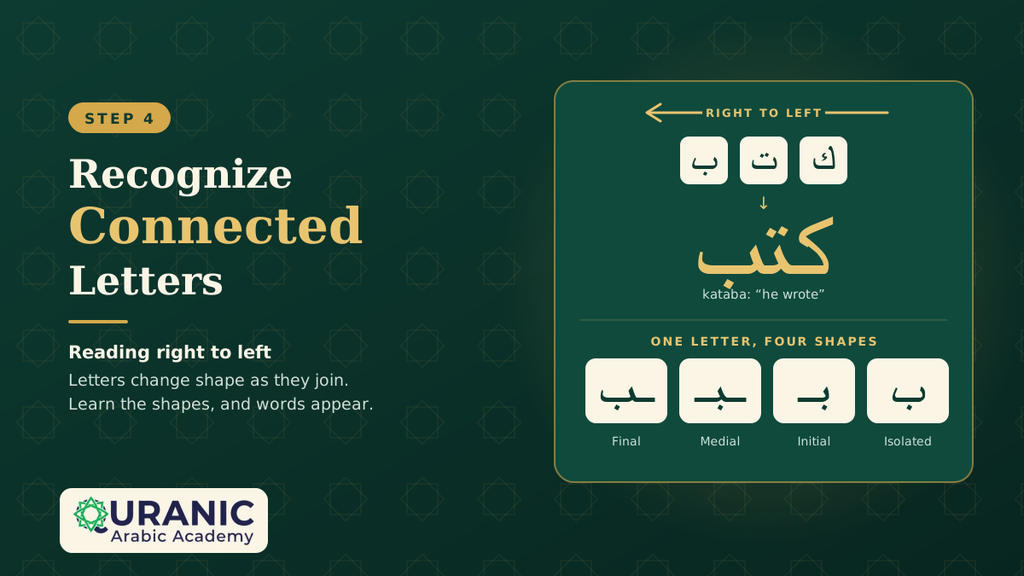
You’ve learned the letters one by one. Now comes the moment they come alive. In Arabic, letters don’t stand alone on the page like beads scattered on a table. They reach for each other, link hands, and flow together into words. That’s the beauty of Arabic script, and for many beginners it’s also the first real surprise.
The letter you memorized so carefully can suddenly look different once it joins a word. It may lose its tail, shrink to a small hook, or stretch to connect with the letter beside it.
| Position | Form of ب | Quranic example |
|---|---|---|
| Beginning | بـ | بِسْمِ |
| Middle | ـبـ | قَبْلَ |
| End (connected) | ـب | قَلْبٌ |
| Alone | ب | كِتَابٌ |
Notice that ب stands alone in كِتَابٌ. That happens because the letter before it, Alif, never connects forward. Six letters behave this way: ا د ذ ر ز و. They join the letter before them but never the letter after them.
Step 5: Read Your First Words With the Scan, Apply, Blend Method
This is the moment you’ve been working toward. You know the letters, you’ve trained your makharij, and you can recognize letters even when they join together. Now it’s time to put it all together and read your first real words.
For many beginners, this step brings a mix of excitement and nerves. Looking at a full Arabic word for the first time can feel like standing at the edge of a pool, unsure whether to dive in. The good news is that you don’t have to jump. You can wade in one step at a time.
That’s where the Scan, Apply, Blend method comes in. It’s a simple three-part approach that turns a confusing cluster of shapes into a word you can actually say.
First, you scan the word to identify each letter. Next, you apply the vowel marks so you know exactly how each letter should sound. Finally, you blend those sounds together smoothly, from right to left, until the word flows. Use this three-part method on every new word:
- Scan: Identify each letter from right to left.
- Apply: Add the sound of each Harakah.
- Blend: Join the sounds smoothly into one word.
Example 1: خَلَقَ (He created). Scan: خ ل ق. Apply: kha + la + qa. Blend: khalaqa.
Example 2: رَبِّ (Lord). Scan: ر ب. Apply: ra + bbi (the Shaddah doubles the b). Blend: rabbi.
Sun and moon letters. The word for “the” in Arabic is ال (al). With moon letters, you pronounce the Lam: الْقَمَرُ = al-qamaru. With sun letters, the Lam goes silent and the next letter is doubled: الشَّمْسُ = ash-shamsu. The visual shortcut: if the letter after ال carries a Shaddah, skip the Lam.
The connecting Alif (Hamzat al-Wasl). An Alif at the start of words like ال is pronounced only when you start reading from it. When it follows another word, you skip it. That is why بِسْمِ اللَّهِ is read bismillāh, not “bismi allāh”.
For a deeper walkthrough, see our guide on how to read the Quran word by word.
See It in Action
Wondering what our interactive sessions look like? Click below to peek inside a live session and watch how our expert instructors make learning Quranic Arabic accessible and engaging.
Ready to Begin Your Quranic Journey?
Start learning with professional instructors through our structured curriculum.
Book Your Free TrialStep 6: Start With Short Surahs From Juz’ Amma
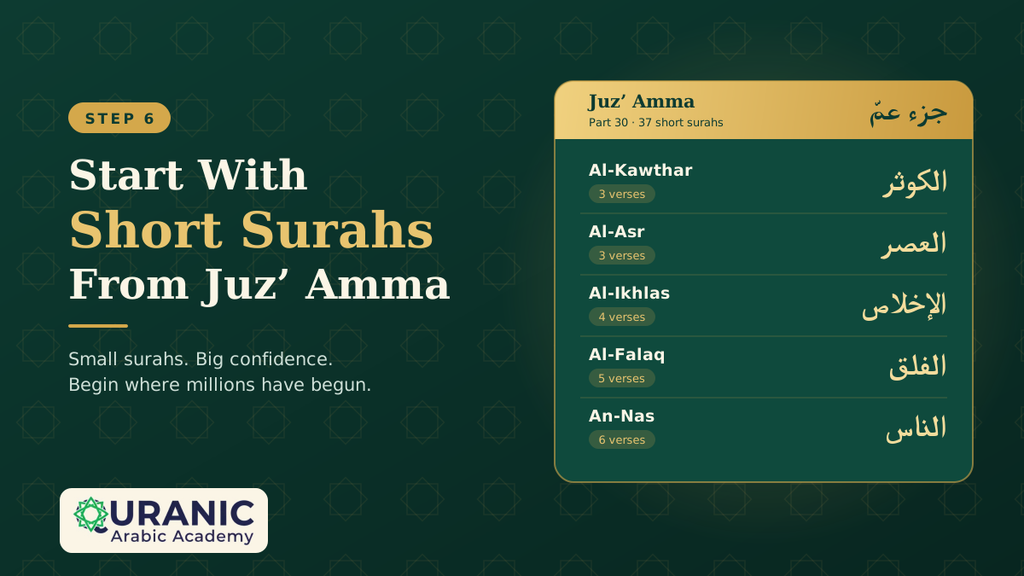
Now that you can read your first words, it’s time to step into the Quran itself. You don’t need to start with the longest chapters. The best place for a beginner is Juz’ Amma, the thirtieth and final part of the Quran.
It holds 37 short surahs, from An-Naba’ to An-Nas, and many of them are only a few lines long. Some are so short you can read one completely in under a minute. Al-Kawthar, the shortest surah in the entire Quran, has just three verses.
But Juz’ Amma is more than a gentle starting point. It’s where so many Muslims around the world begin their relationship with the Quran.
These are the surahs children memorize first, the ones you hear recited in daily prayers, and the ones that may already sound familiar even if you’ve never read them yourself. Follow this order:
- Al-Ikhlas (4 verses): Short, repetitive, and full of the rules you just learned.
- Al-Kawthar (3 verses): The shortest Surah in the Quran; a quick confidence win.
- Al-Asr (3 verses): Introduces Shaddah and long vowels in a short space.
- An-Nas (6 verses): Repeats the same ending sound, which trains your rhythm.
- Al-Falaq (5 verses): Contains several heavy letters for Makharij practice.
- Al-Fatihah (7 verses): You already recite it in every Salah; now read it from the page.
Worked example, Al-Ikhlas, verse 1:
قُلْ هُوَ اللَّهُ أَحَدٌ
“Say, ‘He is Allah, [who is] One'”
- قُلْ: Qaf with Damma, then Lam with Sukoon = qul
- هُوَ: Ha with Damma, then Waw with Fatha = huwa
- اللَّهُ: The connecting Alif is skipped, so it joins the previous word = huwa-llāhu
- أَحَدٌ: Ends with Tanween, but at the end of a verse you stop on a Sukoon = aḥad
That last point is a beginner’s first stopping rule: when you pause at the end of a verse, drop the final vowel and the Tanween.
Step 7: Add Basic Tajweed and Learn Mushaf Symbols
By now you can read Arabic words, blend sounds together, and work through short surahs on your own. That’s a huge milestone. But if you listen closely to a skilled reciter, you’ll notice something more. Some sounds are stretched, others are softened or carried through the nose, and the reciter pauses in some places but never in others.
The word comes from an Arabic root meaning “to make excellent,” and it’s what turns correct reading into recitation that sounds the way the Quran was revealed.
Don’t let the word intimidate you. You don’t need to master every rule at once, and you don’t need to memorize a whole textbook. In this step, you’ll add just the basics, one rule at a time, starting with the ones that appear most often in the surahs you’re already reading. Along the way, you’ll also learn to decode the small symbols printed throughout the mushaf:
- Ghunnah: A two-beat nasal sound on نّ and مّ (Noon and Meem with Shaddah).
- Natural Madd: Long vowels held for two beats, as you learned in Step 3.
- Qalqalah: A slight echo on ق ط ب ج د when they carry a Sukoon. Remember them as qutbu jad.
- Noon Sakinah and Tanween: Four rules (Izhar, Idgham, Iqlab, Ikhfa) for how ن and Tanween sound before different letters. Learn them one at a time.
You will also see small symbols above the lines of the Mushaf. These are stop signs (Waqf). The most common ones in the Madani Mushaf are:
| Symbol | Meaning |
|---|---|
| with a number | End of a verse; you may stop here |
| مـ | Stopping is required |
| لا | Do not stop here |
| ج | Stopping and continuing are both allowed |
| صلى | Continuing is preferred |
| قلى | Stopping is preferred |
IndoPak Mushafs use some different symbols, so check the guide page at the back of your copy. To see how Tajweed fits into recitation as a whole, read our guide to Tilawah, Tajweed, and Tarteel.
Step 8: Listen, Repeat, Compare, and Get Feedback
You can read Arabic words now, and you’ve started on the short surahs of Juz’ Amma. That’s a real achievement. But reading correctly and reciting beautifully are two different things, and the gap between them is where many self-taught learners get stuck. You might be pronouncing a letter slightly wrong, stretching a sound too long, or missing a rule without realizing it.
The tricky part is that you can’t always hear your own mistakes. What sounds right in your head may not match how the Quran is meant to be recited.
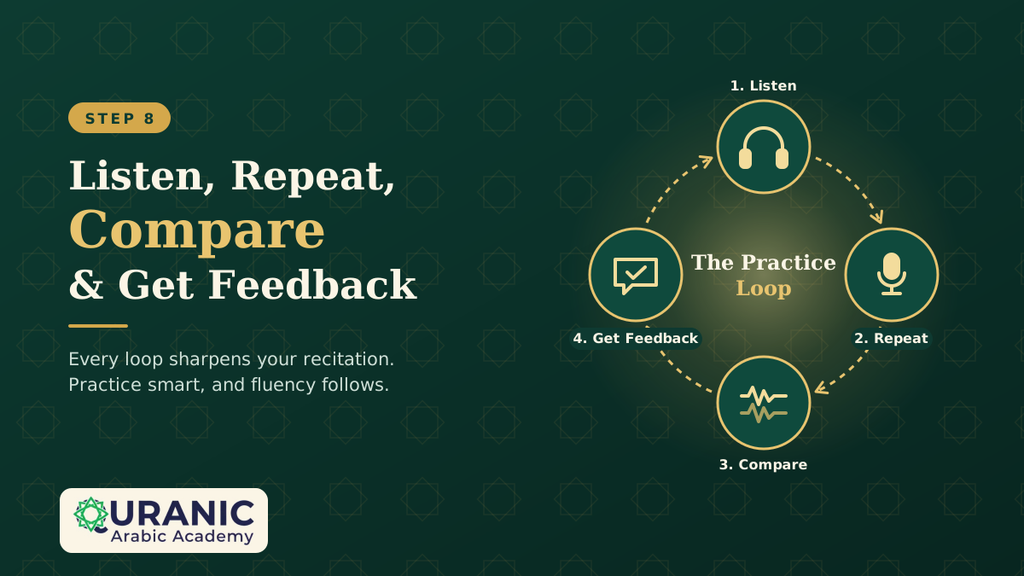
That’s why this final step matters so much. The Quran has been passed down through generations by listening and reciting, from teacher to student, all the way back to the Prophet ﷺ. Learning to recite today works the same way. Use this active loop instead:
- Listen to one verse while following the Arabic text with your finger.
- Repeat it aloud straight after the reciter.
- Read the same verse alone, without audio.
- Compare by recording yourself and playing it beside the reciter.
- Fix one word that sounded different, then repeat the whole verse.
Audio shows you the correct sound, but it can’t tell you whether your sound is correct. Some errors in Makharij, vowel length, or Ghunnah are almost impossible to hear in your own voice.
A qualified teacher catches them in seconds. If you’re studying alone for now, our guide on how to learn to read Quran by yourself explains how to get the most from self-study.
Can You Read the Quran in Arabic Without Speaking Arabic?
Yes. Reading the Quran and understanding Arabic are two separate skills, and you can learn the first without the second. Reading means recognizing letters, applying vowel marks, and producing the correct sounds.
Understanding means learning vocabulary, grammar, and the structure of Quranic Arabic. Millions of Muslims around the world recite the Quran accurately before they understand a single sentence of it.
Start with reading. Understanding can come next, built on the same foundation. When you’re ready for that second stage, our guide on how to read and understand the Quran explains how the two skills connect.
What You Need Before You Start Reading the Quran in Arabic?
You need very little to begin, but choosing the right tools on day one saves you weeks of confusion. Before you learn how to read Quran in Arabic for beginners, prepare these five things:
- A Mushaf with full Harakat. Beginners need every vowel mark visible. Mushafs come in two common scripts: the Uthmani (Madani) script, widely used in the Arab world, and the Indo-Pak script, common in South Asia. Both are correct. Pick one and stay with it, because the letter shapes and symbols differ slightly.
- A Noorani Qaida. This classic primer teaches letters, vowels, and joining rules in a carefully graded order. It is the most proven shortcut for beginners.
- One clear reciter. Choose a slow, precise reciter, such as Sheikh Mahmoud Khalil Al-Husary, and use the same voice for all your listening practice.
- 15–20 quiet minutes a day. Short daily sessions beat long weekly ones.
- A source of feedback. A qualified teacher hears mistakes you can’t hear yourself.
The Easy Way to Read Quran in Arabic: A 30-Day Beginner Plan
Knowing the steps is one thing. Following them every day is another. Many beginners start learning to read the Quran in Arabic full of motivation, and then real life gets in the way. One day they practice letters, the next they jump to a surah, and the day after they aren’t sure what to do at all.
Without a clear path, even the most sincere intention can fade into “I’ll start again next week.” The problem usually isn’t a lack of desire or ability. It’s not knowing what to focus on today.
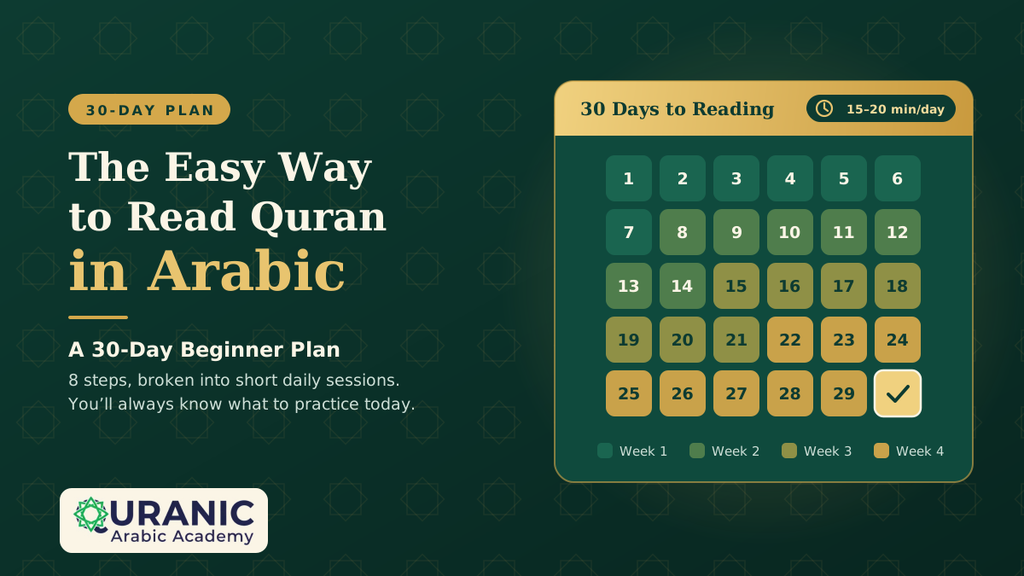
The easy way to read Quran in Arabic is to follow a plan, so you always know what to practice today. This 30-day plan turns the eight steps into short daily sessions of 15-20 minutes, about the time it takes to drink a cup of tea. Each day builds on the one before it.
| Week | Focus | Daily tasks (15–20 min) | You’re ready to move on when… |
|---|---|---|---|
| Week 1 (Days 1–7) | Letters by shape family | Learn 1–2 shape families a day; say each letter aloud; review yesterday’s letters first | You can name all 28 letters in random order |
| Week 2 (Days 8–14) | Harakat and Makharij | Read each letter with Fatha, Kasra, and Damma; practice the light and heavy pairs; add Sukoon, Shaddah, and Tanween | You can read any single letter with any vowel mark |
| Week 3 (Days 15–21) | Connected letters and word blending | Read 10 short words a day with Scan, Apply, Blend; practice sun and moon letters | You can sound out an unfamiliar three-letter word on your own |
| Week 4 (Days 22–30) | Short Surahs and first Tajweed rules | Read Al-Ikhlas, Al-Kawthar, and Al-Asr with audio; add Ghunnah and Madd; mark stop signs | You can read one short Surah from the page with few mistakes |
If you fall behind, don’t skip ahead. Repeat the week until you meet its “ready” check. Going slower with accuracy is always faster in the long run.
How Long Does It Take to Read the Quran in Arabic?
There is no fixed timeline, because progress depends on how often you practice, whether someone corrects your mistakes, and any earlier exposure to Arabic. It is more useful to measure progress by milestones than by months:
- Letter stage: You recognize every letter and its sound.
- Word stage: You can sound out new words using Harakat and joining rules.
- Short Surah stage: You read Juz’ Amma from the page, slowly but correctly.
- Fluent reading stage: You read any page of the Mushaf at a steady pace while applying basic Tajweed.
Learners who practice daily with a teacher usually reach each milestone much sooner than those who study occasionally alone. Adults often worry they have left it too late. They haven’t: read our guide on whether adults can learn to read the Quran.
Tips to Make Reading the Quran in Arabic Easier
Every learner hits a point where progress feels slower than they’d hoped. A letter keeps getting mixed up with another, a word refuses to flow, or a busy week breaks the daily habit you worked so hard to build.
These moments are normal, and every fluent reader of the Quran has gone through them. Often what separates those who keep going from those who give up isn’t talent or free time. It’s knowing the small habits and smart shortcuts that make the journey lighter.
That’s what this section is about. These are simple, practical tips you can start using today to make reading the Quran in Arabic feel easier, smoother, and more enjoyable. Some will help you remember letters and rules faster.
- Use one Mushaf. Your eyes learn its layout, font, and symbols faster.
- Try a color-coded Tajweed Mushaf. Colors flag Ghunnah, Madd, and Qalqalah before you know every rule.
- Always read aloud. Silent reading hides pronunciation mistakes.
- Review before you learn. Spend the first minutes of every session on yesterday’s material.
- Phase out transliteration early. Use it for a week at most, then cover it.
- Read with your finger. Tracing each word from right to left keeps your place and your focus.
- Keep a mistakes list. Write down the words you stumble on and start tomorrow with them.
- Choose accuracy over speed. Fluency follows naturally. When you’re ready to pick up pace, see how to read Quran faster with full accuracy.
Experience Our Teaching Style:
We believe in clarity and engagement. Watch these short highlights from our actual classes to see our teachers’ methodology and student interactions in real-time.
Ready to Begin Your Quranic Journey?
Start learning with professional instructors through our structured curriculum.
Book Your Free TrialLearn to Read the Quran in Arabic With The Quranic Arabic Academy
The steps in this guide work, but they work faster when someone listens to you read. The Quranic Arabic Academy is an online Quranic school that takes beginners from their first letter to confident recitation, and then on to understanding what they read.
- Certified native Arab tutors. Every instructor holds an Ijazah in Quranic recitation or a degree in Islamic studies. Meet them on our teachers page.
- Live one-on-one sessions. No group pace to keep up with. Your tutor focuses only on your mistakes.
- Real-time Makharij correction. The heavy letters from Step 2 are exactly what our tutors correct live, watching your mouth position over video.
- A structured path from Noorani Qaida. You start with letters and Tajweed basics, then progress at your own pace.
- Written feedback after every session. You always know which rules you’ve mastered and what to practice next. Parents of younger students also receive monthly progress reports.
- Flexible schedules worldwide. Book classes around your work, family, and prayer times, whether you live in the US, UK, Europe, the Gulf, or Asia.
Book your free trial lesson and read your first verse with a tutor this week.
Our Arabic Courses
- Quranic Arabic Classes
- Quranic Arabic Course for Beginners
- Online Quranic Arabic Courses for Advanced Learners
- Quranic Arabic Grammar Course
- Arabic Courses for Understanding the Quran
Conclusion
Learning how to read the Quran in Arabic easy comes down to doing the right things in the right order. Every fluent reciter you’ve ever admired, every voice that moved your heart in prayer, once started exactly where you are now: staring at unfamiliar letters and wondering if they’d ever make sense.
The truth is that learning how to read the Quran in Arabic easy doesn’t take a special gift, years of free time, or a perfect memory. It comes down to doing the right things in the right order.
Start by learning the letters by shape family, so the alphabet feels organized instead of overwhelming. Master the Harakat, so every letter gets its correct sound. Read connected words with the Scan, Apply, Blend method, and watch scattered shapes turn into words you can say with confidence.
Then bring it all to life by practicing on short Surahs, adding Tajweed one rule at a time instead of trying to learn everything at once.
Most importantly, be consistent. Keep your sessions short and daily, because 15 minutes every day will take you further than two hours once a week. Let a qualified teacher check your recitation, so small mistakes are caught early and never become habits. That is how to read Quran in Arabic for beginners without feeling overwhelmed: one letter, one word, and one verse at a time.
FAQs
Can I read the Quran in Arabic if I don’t speak Arabic?
Yes. Reading the Quran requires recognizing letters, vowel marks, and sounds, not speaking the language. Many Muslims recite accurately before they understand Arabic. Understanding the meaning is a separate skill you can build afterward with Quranic Arabic study.
What is the easiest way to read Quran in Arabic?
The easiest way is to learn letters by shape family, then the Harakat, then connected words, and to practice on short Surahs from Juz’ Amma. Short daily sessions of 15–20 minutes and regular feedback from a teacher make the process much smoother.
Is Noorani Qaida necessary for beginners?
It isn’t required, but it is the most proven tool for beginners. Noorani Qaida teaches letters, vowels, and joining rules in a carefully graded order, so you build each skill before you need it in the Mushaf.
Can adults learn to read the Quran?
Yes. Adults often progress quickly because they practice with focus and clear goals. Age matters far less than consistency and correction. Our Quran reading guide for adults covers the adult learning path in detail.
Should beginners use an Uthmani or IndoPak Mushaf?
Both are correct. The Uthmani (Madani) script is common in the Arab world and in most online resources, while IndoPak is common in South Asia. Choose the one your teacher or community uses, and stick with it.
Related Articles
Quranic Grammar






Leave a Reply