 Quran
Have you ever looked at the Quran and wished you could read its beautiful verses but didn’t know where to begin because you can’t read Arabic? You don’t have to let that stop you. Learning how to read Quran If You Don’t Know Arabic is possible even if you’re starting from zero, and you don’t need to become fluent in Arabic before taking your first step.
With the right approach, you can learn the Arabic alphabet, recognize Quranic words, understand basic pronunciation rules, and gradually read verses with confidence.
this beginner-friendly guide, we’ll walk you through 7 clear, practical steps to help you start reading the Quran without knowing Arabic, avoid common learning mistakes, and build a consistent reading habit. Follow these steps in order. Each one ends with a milestone, so you know when you are ready to move on.
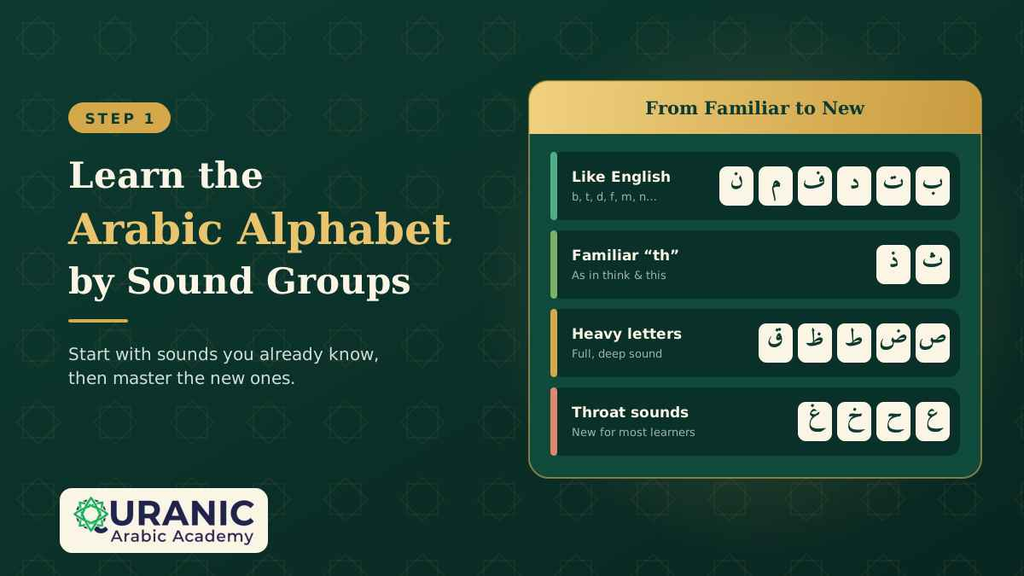
Step 1 – Learn the Arabic Alphabet by Sound Groups
Arabic has 28 letters, written right to left. Most letters change shape depending on whether they stand alone or sit at the start, middle, or end of a word.
Do not learn them in alphabetical order. Learn them by where they come from in the mouth (Makharij). For example, study the throat letters ء ه ع ح غ خ together, because practising them as a family trains the throat faster.
Some letters have no English equivalent. These pairs cause the most mistakes for non-Arabic speakers:
| Letters | How they differ | Practice tip |
|---|---|---|
| ح vs ه | ح is a tight, breathy sound from the middle of the throat; ه is a soft “h” from the deepest part | Say ه, then squeeze the throat for ح |
| ع vs ء | ع is a voiced squeeze in the middle throat; ء is a short stop, like the break in “uh-oh” | Hum while tightening the throat for ع |
| ص vs س | ص is heavy, with the back of the tongue raised; س is a light English “s” | Say “s” while rounding the mouth for ص |
| ض vs د | ض is heavy, made with the side of the tongue on the upper molars; د is a light “d” | Ask a teacher to check ض early; it is the hardest letter |
| ط vs ت | ط is a heavy, full-mouth “t”; ت is light | Keep the tongue low and back for ط |
| ق vs ك | ق comes from the very back of the tongue, deeper than ك | Feel the back of the tongue touch the soft palate for ق |
| ظ vs ذ | Both use the tongue tip on the upper teeth; ظ is heavy, ذ is light like “th” in “this” | Raise the back of the tongue for ظ |
For a deeper walkthrough of the script, see our guide on how to read Arabic Quran.
Step 2 – Master the Vowel Marks (Harakat), Sukoon, Shaddah and Tanween
If English is your first language, you already know how unpredictable spelling can be. Look at though, through, and tough: the same four letters, “ough,” make three completely different sounds, and nothing on the page tells you which one to use. You simply have to memorize it. Now here’s the good news: Quranic Arabic doesn’t work that way.
Every word in the Mushaf carries small marks that tell you exactly how it should sound. Nothing is left to guesswork. Once you learn to read these marks, you can pronounce words you’ve never seen before, correctly, on your very first try.
This step teaches you that system. You’ll start with the three short vowels, the Harakat. Fatha gives an “a” sound, Kasra gives “i,” and Damma gives “u.” Next comes the Sukoon, which tells you to close a sound with no vowel.
The Shaddah tells you to double a letter and press on it with emphasis, and Tanween adds a soft “n” sound to the end of a word. Together, these few small symbols unlock the pronunciation of every word in the Quran.
| Mark | Sound | Example from the Quran |
|---|---|---|
| Fathah ( َ ) | short “a” | رَبِّ (Rabbi) |
| Kasrah ( ِ ) | short “i” | بِسْمِ (Bismi) |
| Dammah ( ُ ) | short “u” | نَعْبُدُ (Na’budu) |
| Sukoon ( ْ ) | no vowel; the letter stops | الْحَمْدُ (Al-ḥamdu) |
| Shaddah ( ّ ) | the letter is doubled | رَبِّ (Rabbi, “bb”) |
| Tanween ( ً ٍ ٌ ) | vowel + “n” at the end | أَحَدٌ (Aḥadun) |
| Long vowels (ا و ي) | stretched “aa”, “oo”, “ee” | مَالِكِ (Maaliki), الرَّحِيمِ (Ar-Raḥeem) |
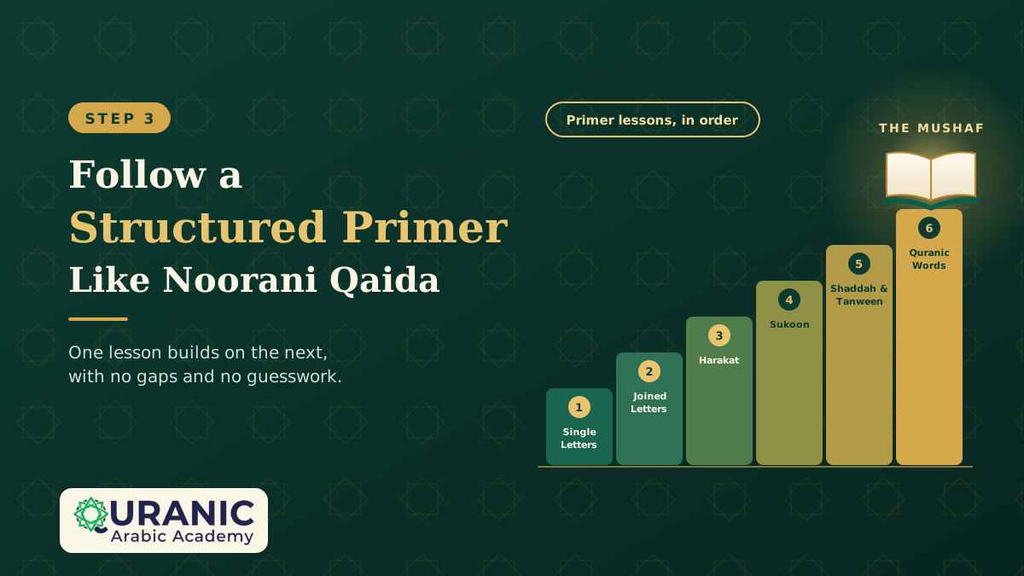
Step 3 – Follow a Structured Primer Like Noorani Qaida
Here’s a trap many self-taught learners fall into. They pick up a letter from one app, a vowel rule from a YouTube video, and a pronunciation tip from a friend. A few weeks later, they realize their knowledge is full of gaps. They know some things well, other things not at all, and they’re unsure what to practice next.
Learning to read the Quran this way is like building a house without a blueprint. You might get a few walls up, but the foundation will never feel solid.
That’s why a structured primer makes such a difference. The Noorani Qaida is one of the most widely used Quran-reading primers in the world, taught in mosques, madrasas, and homes across many countries.
It takes you through every skill in a careful, logical order: single letters, joined letters, vowel marks, Sukoon, Shaddah, Tanween, and finally full words drawn from the Quran itself.
Each lesson builds on the one before it, so nothing is skipped and nothing is learned out of order. Other trusted primers, like Al-Qaida Al-Baghdadiyya or Yassarnal Quran, follow a similar step-by-step approach, and the best choice is often the one your teacher uses.
If you want a tutor to guide you through it, our Quranic Arabic for beginners course starts from letter one.
Step 4 – Use Transliteration Only as a Temporary Bridge
When you’re just starting, transliteration can feel like a lifeline. Seeing Qul huwa Allahu ahad written in familiar English letters lets you join in right away, recite along in prayer, and feel connected to the Quran before you can read a single Arabic letter.
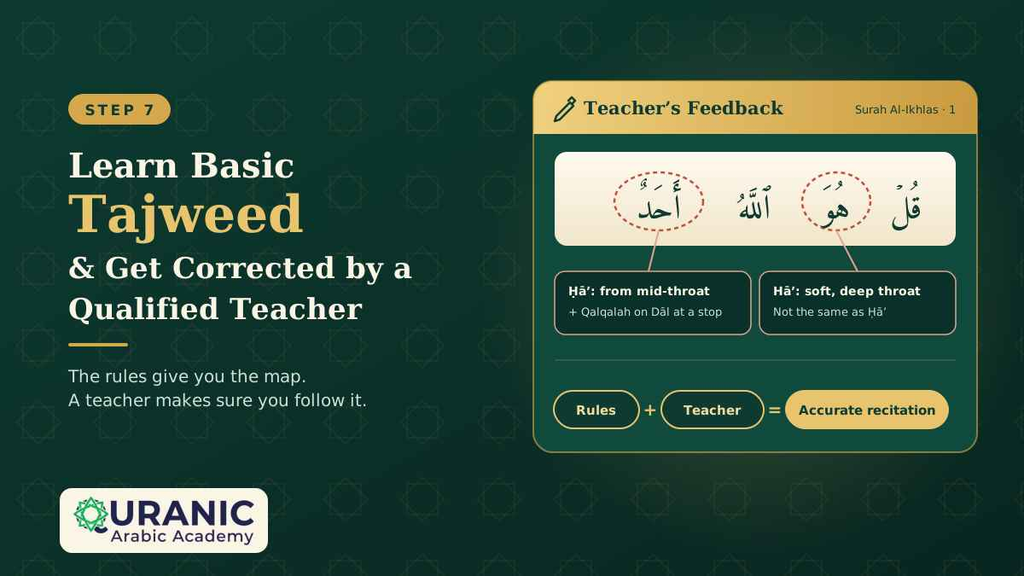
There’s real value in that, and there’s no shame in using it at the beginning. But look closely at that same line from Surah Al-Ikhlas. The “h” in huwa (هُوَ) and the “h” in ahad (أَحَدٌ) are spelled the same in English, yet in Arabic they’re two completely different letters, made in two different parts of the throat. Transliteration simply can’t show the difference.
That’s the hidden cost of leaning on it for too long. English letters have no way to represent sounds like ع, ح, or ق. They can’t tell you which letters are heavy or light, and they can’t show how long to stretch a vowel.
The longer you rely on transliteration, the more those small inaccuracies settle into your recitation, and the harder it becomes to let go. So treat it like a bridge, not a home: something to help you cross the first stretch of your journey, not a place to stay. If you are studying without a teacher for now, our guide to learning to read Quran by yourself explains how to avoid this trap.
See It in Action:
Wondering what our interactive sessions look like? Click below to peek inside a live session and watch how our expert instructors make learning Quranic Arabic accessible and engaging.
Ready to Begin Your Quranic Journey?
Start learning with professional instructors through our structured curriculum.
Book Your Free TrialStep 5 – Listen, Repeat, Compare
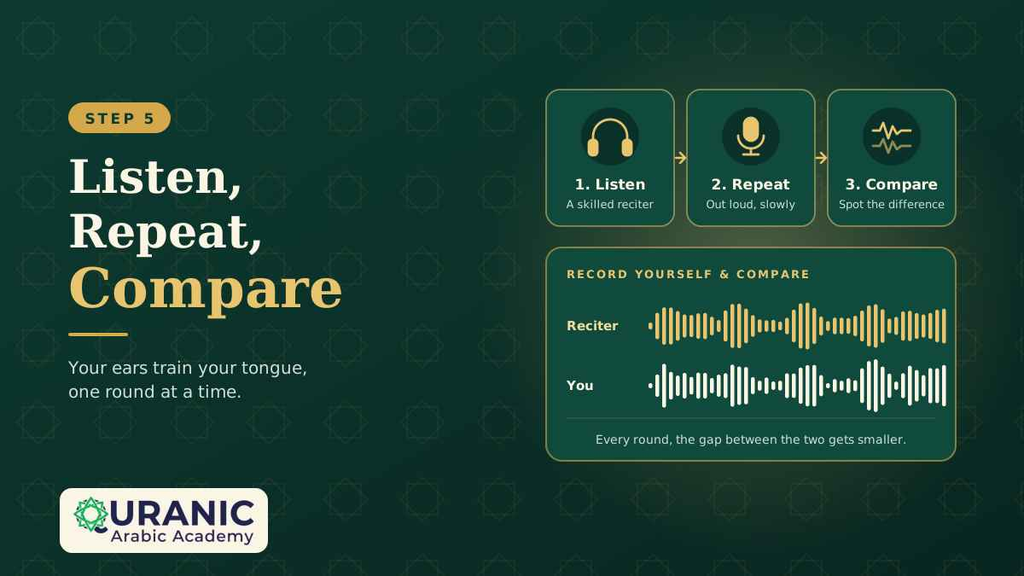
Think about how you learned your first language. You didn’t start with a grammar book or an alphabet chart. You listened. For months, maybe years, you absorbed the sounds around you, tried to repeat them, noticed when they came out wrong, and adjusted until they sounded right.
That natural cycle of hearing, imitating, and correcting is still one of the most powerful ways to learn any sound. It also happens to be how the Quran has been taught for over fourteen centuries: by ear, from one voice to the next.
This step brings that method into your daily practice. First, listen closely to a skilled reciter reading a short passage slowly and clearly. Then repeat it aloud, copying not just the words but the rhythm, the stretched vowels, and the depth of each letter. Finally, compare your recitation with theirs. The easiest way is to record yourself on your phone and play the two back to back.
You’ll be surprised how much you notice: a letter that came out too light, a vowel held too short, a sound that slipped from the throat to the mouth. Choose a slow, clear reciter and use this four-part loop for one ayah at a time:
- Listen to the ayah while following the Arabic with your finger.
- Pause and repeat it aloud.
- Replay the ayah and compare it with your version.
- Correct the sounds that differ, then repeat.
Ten focused minutes of this loop trains both your ear and your tongue. Our guide on how to improve your Quran recitation shares more techniques.
Step 6 – Start Reading Short Surahs From the Mushaf
Up to now, your practice has lived in primers, apps, and lesson pages: letters on worksheets, words in neat rows, sometimes with transliteration nearby for support. This step is different.
Now you open the Mushaf itself, the same pages Muslims around the world recite from in their homes, mosques, and prayers. There’s no English underneath to lean on and no simplified layout. It’s just the words of Allah, exactly as they’ve been written and read for generations.
For many non-Arab learners, the first time they read a full surah directly from the Mushaf is one of the most emotional moments of the entire journey. Start with surahs you already recite in Salah, because familiar sounds make decoding easier:
- Al-Fatiha
- An-Nas
- Al-Falaq
- Al-Ikhlas
- Al-Kawthar
One point confuses many non-Arab beginners: Mushafs come in different scripts. The Uthmani script (used in the Madinah Mushaf) is common in the Arab world. The IndoPak script, with thicker letters and extra marks, is common in South Asia. Both contain the same Quran. Pick one and stay with it while you learn.
To build accuracy one word at a time, follow our method to read Quran word by word.
Step 7 – Learn Basic Tajweed and Get Corrected by a Qualified Teacher
You can read every book ever written about swimming and still sink the first time you jump into the water. Some skills can only be learned with someone beside you, watching closely and correcting you in the moment.
Tajweed is one of them. You can study the rules on paper, memorize the names, and understand the theory perfectly, yet still pronounce a letter slightly wrong or cut a vowel short without ever realizing it. The rules give you the map. A teacher makes sure you actually follow it.
Scholars have treated Tajweed with great seriousness for centuries. The great Quran scholar Imam Ibn al-Jazari, whose famous poem on Tajweed is still memorized by students today, described applying its rules as a firm necessity for anyone who recites the Quran. The good news is that the basics are well within your reach. I
n this step, you’ll start with the core rules beginners need most: the rules of Noon Sakinah and Tanween, Meem Sakinah, Qalqalah, and Madd. Even more importantly, you’ll recite in front of a qualified teacher who can hear what you can’t, correct small mistakes before they become habits, and show you the right sound right away.
Our guide to Tajweed and Tarteel explains each in detail.
Then recite to a qualified teacher. A teacher hears Makharij errors you cannot hear in your own voice, and fixes them before they become habits. This is why our Quranic Arabic classes for adults are taught one-on-one.
How to Understand What You Read Without Knowing Arabic
Have you ever finished reading a Quranic verse and wondered what Allah is telling you through those beautiful words? You don’t need to know Arabic to begin connecting with the meaning of the Quran. Even as a non-Arabic speaker, you can develop a deeper understanding of what you read through reliable translations, simple explanations, and thoughtful reflection.
The key is to go beyond simply reading the words. By following a few practical steps, you can understand Quranic messages, reflect on their meanings, and gradually build a stronger connection with the Book of Allah, even if Arabic is not your first language.
Then learn high-frequency Quranic words. A small set of common words appears again and again across the Quran, so each one you learn unlocks many verses:
| Arabic | Transliteration | Meaning |
|---|---|---|
| قَالَ | Qaala | He said |
| آمَنُوا | Aamanoo | They believed |
| عَمَل | ‘Amal | Deed, action |
| قَلْب | Qalb | Heart |
| نُور | Noor | Light |
| صِرَاط | Siraat | Path |
| جَنَّة | Jannah | Garden, Paradise |
| أَرْض | Ard | Earth |
| سَمَاء | Samaa’ | Sky, heaven |
| عَلِيم | ‘Aleem | All-Knowing |
Learn 3–5 words a week and look for them as you read. A Quranic Arabic dictionary helps when you meet a new one.
When a translation is not enough, use a beginner-friendly Tafsir to learn the context of an ayah. Our introduction to Quranic Tafsir is a good starting point, and our guide on how to read and understand the Quran puts these tools together.
How Long Does It Take to Read the Quran Without Knowing Arabic?
If you don’t know Arabic, you might wonder how long it will take before you can read the Quran confidently. Will it take weeks, months, or even years? The answer depends on where you start, how often you practice, and the learning approach you follow. The good news is that you don’t need to master Arabic to begin reading the Quran.
With consistent practice, the right learning resources, and guidance from a qualified teacher, you can make steady progress from recognizing your first Arabic letters to reading complete Quranic verses. Let’s explore realistic learning timelines and the factors that can help you reach your goal faster.
| Stage | Typical time | What you can do |
|---|---|---|
| Letters and marks | 2–3 weeks | Decode any letter with its vowel |
| Short surahs | 3–4 weeks | Read Al-Fatiha and the last short surahs slowly |
| Noorani Qaida complete | 2–3 months | Read most words without help |
| Reading fluency | 3–6 months | Read longer passages from the Mushaf |
| Basic Tajweed | 6+ months | Apply common rules consistently |
Once you can read accurately, our tips on how to read Quran faster will help you build speed without losing accuracy.
Experience Our Teaching Style:
We believe in clarity and engagement. Watch these short highlights from our actual classes to see our teachers’ methodology and student interactions in real-time.
Ready to Begin Your Quranic Journey?
Start learning with professional instructors through our structured curriculum.
Book Your Free TrialLearn to Read the Quran With The Quranic Arabic Academy
Knowing the steps is one thing. Having someone guide you through them is what turns effort into real progress. The Quranic Arabic Academy is an online Quranic school built for non-native speakers. We take you from your first Arabic letter, through Noorani Qaida and Tajweed, to understanding the Quran in its own language, without relying on translation.
Why students choose us:
- One-on-one live sessions. Your tutor focuses only on your mistakes, at your pace.
- Qualified tutors. Every teacher holds an Ijazah in Quranic recitation or a degree in Islamic studies.
- Real-time Makharij correction. Tutors watch and listen over video and fix pronunciation as you read.
- Reading and understanding together. Lessons connect Tajweed, vocabulary, Nahw and Sarf directly to real ayat.
- Written feedback after every session. You always know what you have mastered and what to practise next.
- Flexible schedules. Classes fit your work, family and prayer times, across every time zone.
Our Arabic Courses
- Quranic Arabic Classes
- Quranic Arabic Course for Beginners
- Online Quranic Arabic Courses for Advanced Learners
- Quranic Arabic Grammar Course
- Arabic Courses for Understanding the Quran
Conclusion
Learning how to read Quran if you don’t know Arabic is not about mastering a new language first. It is about building one skill at a time: the letters, the vowel marks, the short surahs, and then Tajweed and meaning.
Start with the 28 letters and their sounds, follow Noorani Qaida, and use transliteration only as a short bridge. Listen and repeat every day, read from the Mushaf as early as you can, and let a qualified teacher correct you before small mistakes become habits.
Measure your progress in milestones, not pages. Reading Al-Fatiha without transliteration, pronouncing ض correctly, or recognising a word without checking the translation are all real steps forward.
Remember that every effort counts, even when you stumble, because the one who struggles with the Quran earns a double reward. When you are ready for guidance, book a free trial lesson with The Quranic Arabic Academy and take your first step today.
FAQs
Can I read the Quran in English instead of Arabic?
You can read an English translation to learn the meaning, and it is highly beneficial. However, a translation is an interpretation of the meaning, not the Quran’s original wording. For recitation in Salah and the full reward of Tilawah, work toward reading the Arabic text itself.
Is it allowed to read the Quran in transliteration?
Many scholars permit transliteration as a temporary aid for beginners, as long as it is used to learn and not as a permanent replacement. Because it cannot represent every Arabic sound, aim to move to the Arabic script as soon as you can.
Can I pray if I can’t read Arabic yet?
Start with Quran reading. Learning the alphabet, vowel marks and short surahs gives you immediate benefit in prayer. You can add Quranic vocabulary and grammar alongside it, and build toward full understanding step by step.
Do I need Tajweed before I start reading?
No. Begin with correct letter sounds and vowel marks first. Once you can read a short surah without stopping, add basic Tajweed rules such as Madd, Ghunnah and Qalqalah, ideally with a teacher.
Can adults and reverts learn to read the Quran from zero?
Yes. Adults often learn faster than children because they practise with focus and clear goals. With 20 minutes a day and a teacher’s correction, most adults read short surahs within weeks. Our Quran reading guide for adults shows you where to begin.




Leave a Reply