 Learn Quranic Arabic
You’ve opened the Mushaf more than once. Maybe it was in Ramadan, maybe after a moving recitation, or maybe on a quiet night when you simply wanted to hear the words of Allah in your own voice.
Each time, you meant it: this time, I’ll finally read it myself. Then the letters blurred together, the small symbols scattered across the page made no sense, and you didn’t know where to begin. Slowly the Mushaf went back on the shelf, and the habit faded before it ever took root.
If that sounds familiar, you’re not alone, and it isn’t your fault. Most people struggle because nobody ever showed them the right order to learn in. This guide changes that. It shows you exactly how to read Quranic Arabic step by step, from your very first letter to your first full surah, in a clear path you can actually follow.
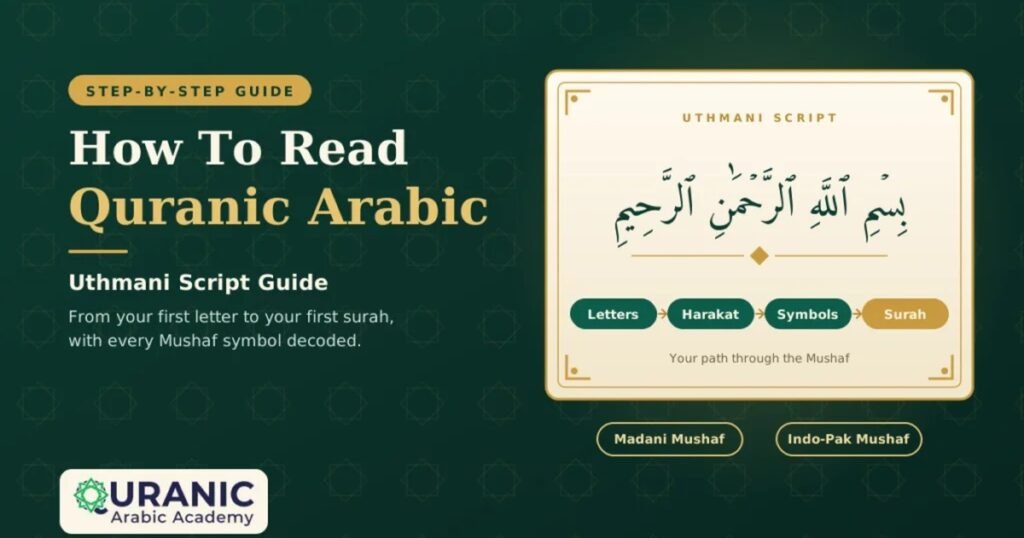
Unlike most beginner guides, this one doesn’t stop at the alphabet. It also decodes the symbols found only in the Uthmani script, the special marks most guides skip, even though they appear on almost every page of the Quran. It explains the differences between the Madani and Indo-Pak Mushaf, so you’ll know exactly which one is in your hands and how to read it.
And it walks you through reading Bismillah letter by letter, so you can see every step come together in the most familiar words in the Quran.
Step 1 – Learn the 28 Arabic Letters and Their Positional Forms
Every page of the Quran, from the opening words of Al-Fatiha to the final verse of An-Nas, is built from just 28 letters. That’s all. Every verse you’ve ever heard recited, every word that has moved hearts for over fourteen centuries, comes from the same small set of building blocks. Learn these 28 letters well, and you’ll hold the key to every single page of the Mushaf.
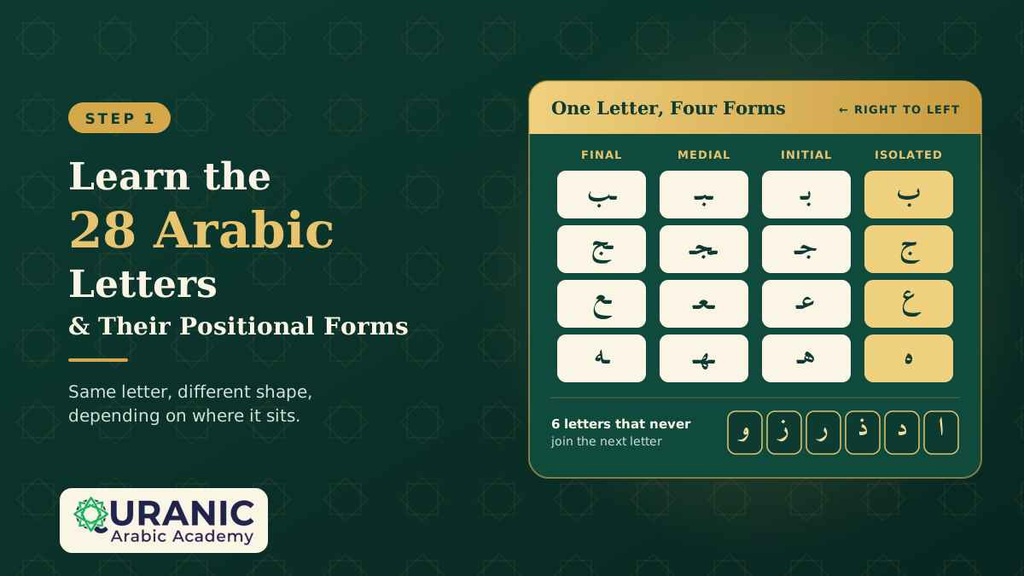
But there’s a twist most beginners don’t expect. Arabic letters don’t always look the same. Because Arabic is written in a flowing, connected script, most letters change shape depending on where they appear in a word: standing alone, at the beginning, in the middle, or at the end.
The letter you recognize perfectly on its own can look like a stranger once it’s joined to its neighbors. On top of that, six letters (ا د ذ ر ز و) never connect to the letter after them, which creates small breaks inside words that can confuse an untrained eye.
| Position | Isolated | Beginning | Middle | End |
|---|---|---|---|---|
| Letter ba | ب | بـ | ـبـ | ـب |
| Letter ‘ayn | ع | عـ | ـعـ | ـع |
Only six letters never connect to the letter after them: ا د ذ ر ز و (alif, dal, dhal, ra, zay, waw). Some guides say eight, but six is the correct number. Once you know these six, you can split any word into its letters.
Use the Noorani Qaida or a similar primer, and give this stage 10 to 15 minutes a day. Most learners recognize every letter within 2 to 4 weeks. For a gentler start, read our beginner’s overview, or begin guided lessons in our Quranic Arabic for Beginners course.
Step 2 – Master the Makharij (Where Each Sound Comes From)
Say the English letter “h.” Now try to find two more versions of it, one from deep in your throat and one from its middle. That’s exactly what Arabic asks of you. Where English has one “h,” Arabic has ه, a soft breath from the deepest part of the throat, and ح, a rougher sound from its middle.
Where English has one “s,” Arabic has the light س and the heavy, full ص. To an untrained ear they can sound almost identical, but in the Quran they’re different letters with different meanings.
سيف (sayf) means “sword,” while صيف (sayf, with a heavy ص) means “summer.” The difference lies entirely in where the sound comes from.
That place is called the makhraj, and together the Makharij are the map of Arabic sound. Scholars of Tajweed identified 17 articulation points spread across five main areas of the mouth and throat: the space of the mouth and throat, the throat itself, the tongue, the lips, and the nasal passage.
Each of the 28 letters has its own exact home on that map. Once you know where a letter lives, you stop imitating sounds and start producing them with precision. This step turns the letters you’ve just learned from shapes on a page into true Quranic sounds, the way they’ve been recited for more than fourteen centuries. These are the pairs English speakers mix up most:
| Often confused | How to tell them apart |
|---|---|
| ت / ط | ط is heavy: raise the back of the tongue and fill the mouth |
| س / ص | ص is the heavy version of س |
| د / ض | ض comes from the side of the tongue against the upper molars |
| ذ / ز / ظ | ذ and ظ need the tongue tip between the teeth; ظ is heavy |
| ه / ح / خ | ه is a soft breath, ح a tight middle-throat sound, خ a rasp from the top of the throat |
| ء / ع | ع squeezes the middle of the throat; ء is a clean stop |
| ك / ق | ق comes from deeper, at the very back of the tongue |
You’ll find more fixes in Common Mistakes When Reading the Quran.
Step 3 – Read the Short Vowels (Harakat), Sukun and Tanween
Here’s something that surprises most beginners: the earliest copies of the Quran had no vowel marks at all. Native Arabic speakers didn’t need them. They knew instinctively how every word should sound.
As Islam spread across the world and millions of non-Arabs embraced the faith, scholars added small marks above and below the letters to protect the correct recitation for everyone.
Those marks are still printed in every Mushaf today, and they were added for people exactly like you: learners who want to read the words of Allah correctly, letter by letter.
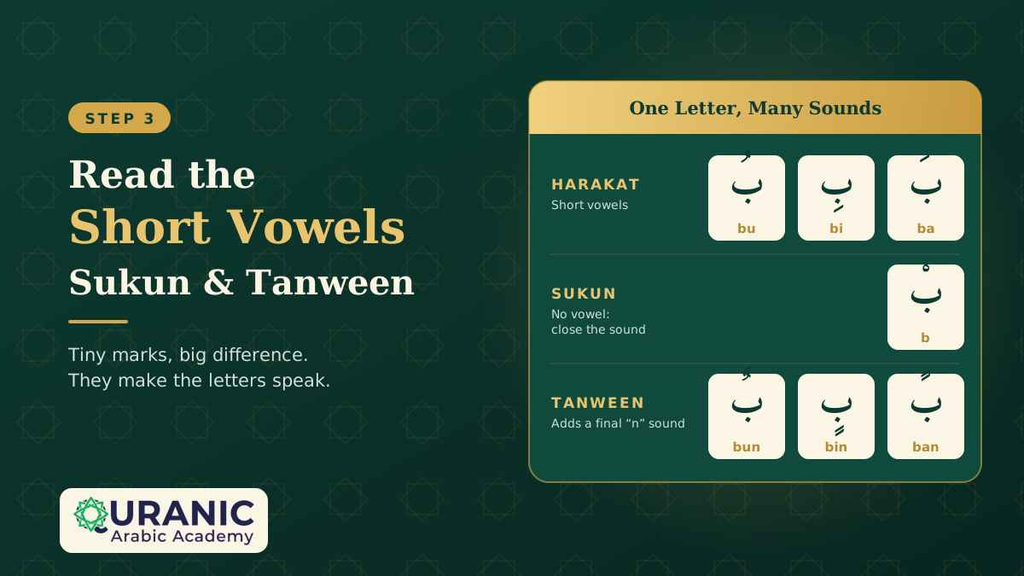
In this step, you’ll learn to read them. First come the three short vowels, the Harakat. Fatha gives an “a” sound, Kasra gives an “i” sound, and Damma gives a “u” sound.
Then comes the Sukun, a small circle that tells you to stop the vowel and close the sound on that letter. Finally you’ll meet Tanween, the doubled vowel marks that add a soft “n” sound to the end of a word.
| Symbol | Name | Sound | Example |
|---|---|---|---|
| ـَ | Fatha | short “a” | بَ = ba |
| ـِ | Kasra | short “i” | بِ = bi |
| ـُ | Damma | short “u” | بُ = bu |
| ـْ | Sukun | no vowel | أَبْ = ab |
| ـً | Tanween fath | “an” | بًا = ban |
| ـٍ | Tanween kasr | “in” | بٍ = bin |
| ـٌ | Tanween damm | “un” | بٌ = bun |
In the Madinah Mushaf, sukun is printed as a small hooked sign, not a circle. The circle means something else, covered in Step 5.
Step 4 – Learn Long Vowels (Madd) and Shadda
Listen to any beautiful recitation of the Quran and you’ll notice its rhythm: some sounds flow and stretch gently, while others land with a firm, doubled emphasis. That rhythm isn’t decoration, and it isn’t left to the reciter’s taste. It’s written right into the text, and two features create most of it: the long vowels, called Madd, and the Shadda. Miss them, and the Quran loses both its music and, very often, its meaning.
Consider how much they change. Add a long vowel to كَتَبَ (kataba, “he wrote”) and you get كَاتِب (kātib, “a writer”). Place a Shadda on عَلِمَ (‘alima, “he knew”) and it becomes عَلَّمَ (‘allama, “he taught”). A single stretched sound or doubled letter turns one word into a completely different one.
In this step, you’ll learn the three Madd letters (ا و ي), how they stretch the short vowels you’ve just mastered, and how long to hold them. You’ll also learn to spot the Shadda, the small symbol shaped like a “w” that tells you to pronounce a letter twice: once to close the sound, and once to open it again.
Step 5 – Decode the Mushaf’s Special Symbols
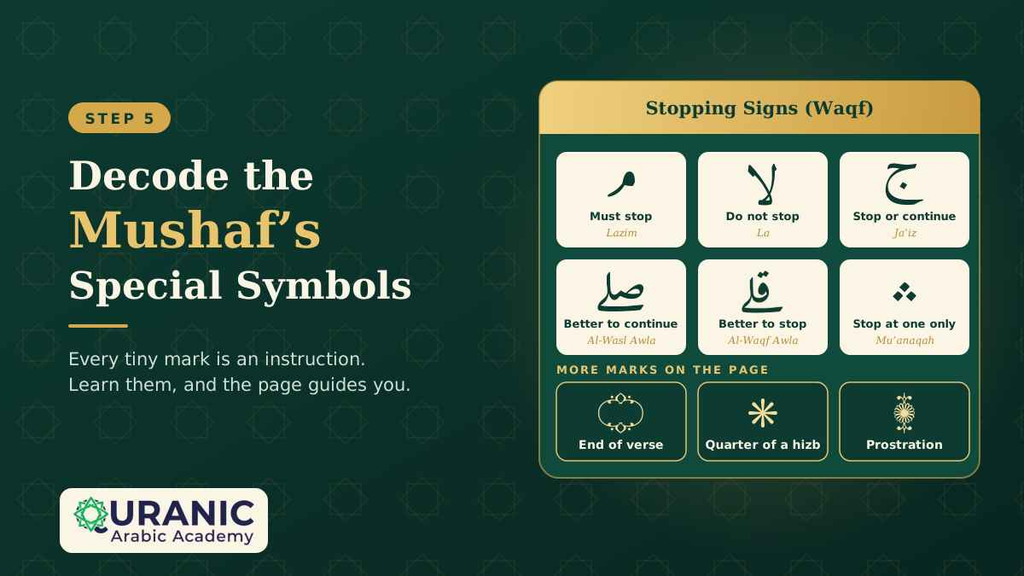
Open any page of the Mushaf and look closely. Between the letters and above the words, you’ll find tiny marks that never appeared in any alphabet chart you studied: a small م floating above a word, the letters لا perched between verses, a little circle sitting on a letter that seems to go silent, a miniature alif tucked above a letter, or three dots arranged in a triangle.
Most beginners skip right over them, assuming they’re decoration or something only scholars need to understand. In fact, each one is a precise instruction, placed there by careful scholarship to protect how the Quran is recited.
These symbols tell you where you must stop, where you must keep going, and where you have a choice. They show which letters are written but not pronounced, which sounds should be stretched, and where a hidden vowel waits to be read.
They even mark the end of each verse, the divisions of the Quran, and the places where a prostration is recommended. Many of these marks belong specifically to the Uthmani script, and some look different in the Madani and Indo-Pak Mushaf, which is why so many readers feel lost even after learning the alphabet.
| Symbol | Name | What to do | Example |
|---|---|---|---|
| ـٰ | Dagger alif (alif khanjariyya) | Read a long “aa” (2 counts), though no full alif is written | ٱلرَّحْمَٰنِ, هَٰذَا |
| ـۥ / ـۦ | Small waw / small ya | Stretch the “hu” or “hi” pronoun ending for 2 counts | إِنَّهُۥ, بِهِۦ |
| ٱ | Hamzat al-wasl | Pronounce it only when you start reading from it; drop it when joining from the previous word | ٱلْحَمْدُ |
| ـ۟ | Small circle | The letter is written but never pronounced | قَالُوا۟, أُو۟لَٰٓئِكَ |
| ۩ | Sajda mark | A verse of prostration | — |
| ۞ | Rub’ al-hizb | Marks a quarter of a hizb, useful for tracking progress | — |
Waqf signs, printed above the line, tell you where to stop or keep going:
| Waqf sign | Meaning |
|---|---|
| مـ | Must stop here; continuing can distort the meaning |
| لا | Do not stop here |
| ج | Stopping and continuing are equally fine |
| صلى | Continuing is preferred |
| قلى | Stopping is preferred |
| ∴ ∴ | Stop at one of the two marks, not both |
Step 6 – Apply Basic Tajweed from Day One
Many beginners think of Tajweed as an advanced subject, something to worry about only after they can already read fluently. So they learn to read without it, practicing every word their own way for months.
Then they discover that they’ve built habits they now have to unlearn: letters that should merge are kept apart, sounds that should echo fall flat, and nasal tones that should flow are cut short. Fixing a habit is far harder than building it right from the start. That’s why Tajweed doesn’t belong at the end of your journey. It belongs at the very beginning.
The good news is that you don’t need to learn every rule at once. In this step, you’ll start with the essential few that appear on almost every page of the Mushaf: the rules of Noon Sakinah and Tanween, Meem Sakinah, Ghunnah, and Qalqalah.
Apply them from day one, one rule at a time, and Tajweed won’t be an extra layer you add later. It will simply become the way you read. Tajweed is the set of rules for reciting the Quran as it was revealed. Allah commands:
وَرَتِّلِ ٱلْقُرْءَانَ تَرْتِيلًا
Wa rattili l-Qur’āna tartīlā
“And recite the Quran with measured recitation.” (Surah Al-Muzzammil, 73:4)
You don’t need every rule at once. Start with the four rules of noon sakinah and tanween, which come up on almost every page:
| Rule | When it applies | Example |
|---|---|---|
| Izhar (clear) | Before the throat letters ء ه ع ح غ خ | مَنْ ءَامَنَ |
| Idgham (merging) | Before the letters ي ر م ل و ن | مَن يَقُولُ |
| Iqlab (changing) | Before ب: noon becomes a hidden meem | مِنۢ بَعْدِ |
| Ikhfa (hiding) | Before the other 15 letters | مِن شَرِّ |
Add two more early: ghunnah, the 2-count nasal sound on a doubled noon or meem (إِنَّ, ثُمَّ), and qalqalah, a light echo on ق ط ب ج د when they carry sukun. Our guide on how to improve Quran recitation covers the next rules.
Step 7 – Practice on Juz Amma, Starting with Al-Fatiha
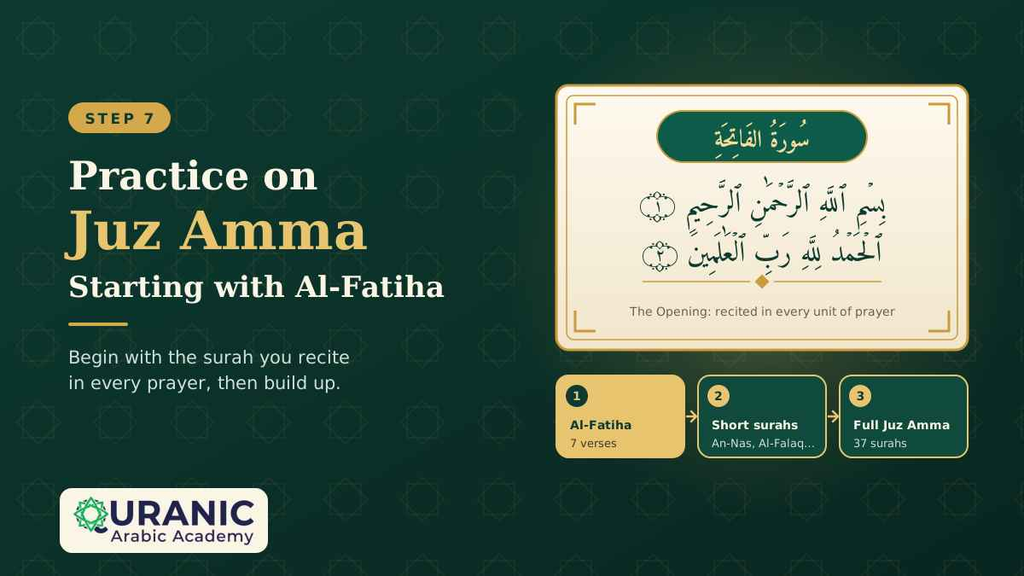
There is one surah every Muslim recites at least 17 times a day: Al-Fatiha. It opens every unit of every prayer, and the Prophet ﷺ taught that there is no prayer without it. If there’s one surah you should read perfectly, letter by letter and rule by rule, it’s this one. That makes it the perfect first passage for everything you’ve learned so far: letters, makharij, harakat, madd, symbols, and Tajweed all come together in just seven verses.
Once Al-Fatiha feels steady, your next stop is Juz Amma, the 30th and final part of the Quran. Its 37 surahs are short, rhythmic, and full of the most familiar words in Muslim life: the surahs you hear in Taraweeh, the ones children memorize first, and the ones you’ve likely recited in your own prayers. Start with the shortest, like An-Nas, Al-Falaq, and Al-Ikhlas, and work your way up.
Each surah gives you a complete, achievable goal and a chance to practice every skill from this guide on real Quranic text. This is where learning turns into reading, and reading turns into a daily connection with the words of Allah. Here is how to read Bismillah, using every step so far:
| Word | How you read it | What’s happening |
|---|---|---|
| بِسْمِ | bis-mi | Kasra on ب, sukun on س, kasra on م. The alif of اسم is not written in the Basmalah at all |
| ٱللَّهِ | -llāhi | Hamzat al-wasl is dropped because you’re joining. Shadda doubles the lam, the dagger alif adds 2 counts, and the lam is light because a kasra comes before it |
| ٱلرَّحْمَٰنِ | -r-raḥmāni | The lam is silent (a sun letter), so ر takes a shadda. The dagger alif adds 2 counts |
| ٱلرَّحِيمِ | ar-raḥīm | Natural madd on ي. When you stop, the last letter takes sukun, and the madd can stretch to 2, 4 or 6 counts |
Read together: Bismi-llāhi-r-raḥmāni-r-raḥīm. Then work through Al-Fatiha, Al-Ikhlas, Al-Falaq and An-Nas, and continue upward through Juz Amma. Our guide to reading the Quran word by word shows this method in more depth.
Step 8 – Read with a Qualified Teacher and Compare with Reciters
The Quran was never meant to be learned from a page alone. The Prophet ﷺ received it from the angel Jibril by listening, and every Ramadan Jibril would review the Quran with him. The Prophet ﷺ then taught it to his Companions the same way, mouth to ear, and they passed it on to the next generation.
That living chain of teacher and student, known as the sanad, has continued unbroken for more than fourteen centuries. When you sit with a qualified teacher today, you’re stepping into that same chain and learning the Quran the way it has always been learned.
There’s also a practical reason this final step matters so much: you can’t always hear your own mistakes. A letter pronounced slightly off, a Madd held too short, or a Ghunnah that’s missing can sound perfectly fine in your own ears. A qualified teacher catches these slips immediately and corrects them before they become habits.
Between lessons, master reciters become your daily reference. Clear, measured recitations, such as those of Sheikh Mahmoud Khalil Al-Husary, let you listen to every verse, recite it yourself, and compare your sound with theirs. To find a qualified tutor, meet our teachers.
See It in Action:
Wondering what our interactive sessions look like? Click below to peek inside a live session and watch how our expert instructors make learning Quranic Arabic accessible and engaging.
Ready to Begin Your Quranic Journey?
Start learning with professional instructors through our structured curriculum.
Book Your Free TrialWhat Is Quranic Arabic, and How Is It Different from Modern Arabic?
Quranic Arabic is the classical Arabic in which the Quran was revealed, written in the Mushaf in the Uthmani script (Rasm Uthmani). It shares its alphabet with modern Arabic, but it is printed fully vowelized and carries extra recitation symbols you won’t see in a newspaper.
Allah describes the Quran’s language Himself:
إِنَّا أَنزَلْنَاهُ قُرْآنًا عَرَبِيًّا لَّعَلَّكُمْ تَعْقِلُونَ
Innā anzalnāhu Qur’ānan ‘arabiyyan la’allakum ta’qilūn
“Indeed, We have sent it down as an Arabic Quran so that you may understand.” (Surah Yusuf, 12:2)
| Quranic (classical) Arabic | Modern Standard Arabic | Spoken dialects | |
|---|---|---|---|
| Where you find it | The Mushaf, salah, tafsir | News, books, formal speech | Daily conversation |
| Vowel marks | Every letter fully marked | Usually left out | Rarely written |
| Extra symbols | Waqf signs, madd marks, dagger alif | None | None |
| Pronunciation rules | Tajweed | Standard grammar | Varies by country |
The good news for beginners: full vowel marks make the Quran easier to read aloud than modern Arabic. Most printed Mushafs follow the reading of Hafs ‘an ‘Asim, so the rules you learn here apply to the copy on your shelf. For a deeper look at recitation itself, see What Is Quranic Recitation?, and for the language behind it, our Arabic courses for understanding the Quran.
Madani vs. Indo-Pak Mushaf – Which Script Should You Learn?
Imagine learning to read the Quran from one Mushaf, then visiting a different mosque, opening their copy, and feeling like a beginner all over again. The letters look thicker or thinner, the symbols seem to be in different places, and some vowel marks appear where you’ve never seen them before.
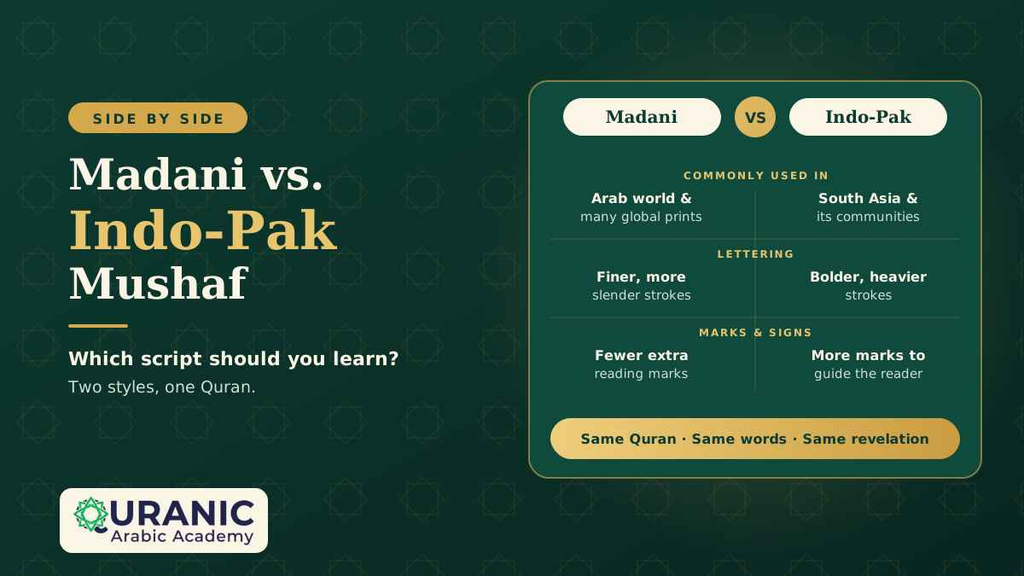
Many learners have this exact experience, and it raises an anxious question: Did I learn the wrong Quran? The answer is a firm and reassuring no. It’s the same Quran, word for word and letter for letter. You’ve simply met the two most widely used styles of the Mushaf: the Madani and the Indo-Pak.
| Madani (Uthmani) Mushaf | Indo-Pak Mushaf | |
|---|---|---|
| Common in | Arab world, most apps, much of the West | South Asia, and South Asian communities in the UK, US and South Africa |
| Letter style | Thinner, elegant Naskh | Bolder, heavier strokes, easier for some beginners |
| Page layout | 604 pages, 15 lines, each page ends at the end of a verse | Usually 13 or 16 lines per page |
| Silent letters | Marked with a small round circle | Usually left with no vowel mark at all |
| Waqf signs | A small set (مـ، لا، ج، صلى، قلى، ∴) | A wider set, including ط، ز، ص |
If you learned with a Noorani Qaida from South Asia, the Indo-Pak style will feel familiar. If you mostly read on a phone app, you’ll usually see the Madani style. Choose one, learn it well, and the other will come quickly.
How Long Does It Take to Learn to Read Quranic Arabic? (12-Week Roadmap)
It’s the question almost every beginner asks before they begin, and sometimes the one that stops them from starting at all: How long will this take? Months? Years? Many people assume that learning to read the Quran in Arabic is a huge undertaking meant only for children in madrasas or people with endless free time. So they put it off, waiting for the “right time” that never seems to come. But the truth is far more encouraging.
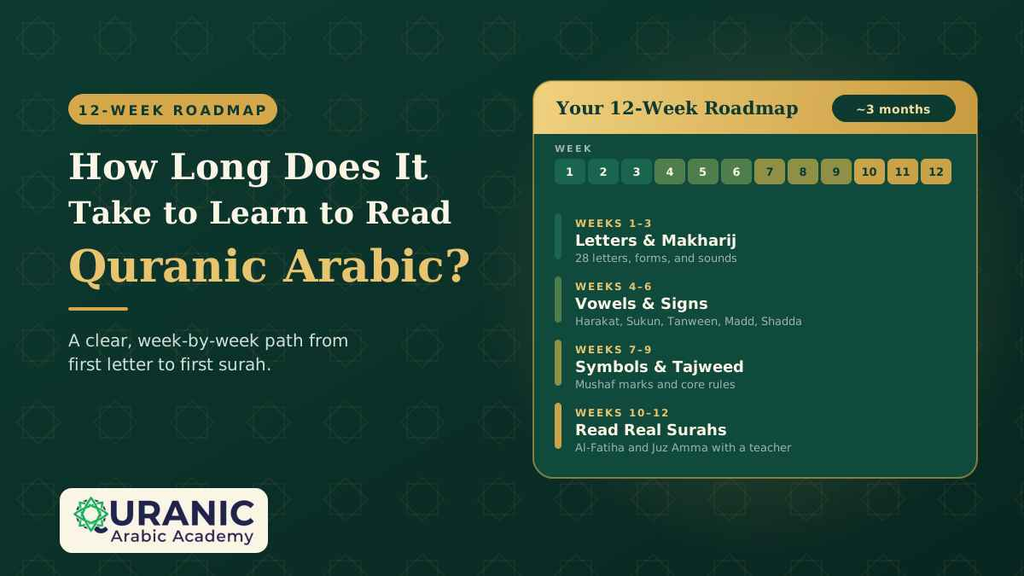
With the right order of learning and steady daily practice, most adult beginners can move from not knowing a single letter to reading short surahs from the Mushaf in about 12 weeks.
| Weeks | Focus | By the end you can… |
|---|---|---|
| 1–3 | Letters and joined forms | Recognize all 28 letters in any position |
| 4–5 | Harakat, sukun, tanween | Read short vowelized syllables and words |
| 6–7 | Madd and shadda | Read full words with long vowels and doubled letters |
| 8–9 | Mushaf symbols and waqf signs | Read a real Mushaf line without getting stuck |
| 10–12 | Basic tajweed and Juz Amma | Recite Al-Fatiha and several short surahs correctly |
These are typical milestones, not deadlines. Moving slower with fewer mistakes beats rushing ahead. If speed is your goal later, read our 10 tips to read Quran faster.
A 20-Minute Daily Practice Routine
Twenty focused minutes a day will take you further than two hours once a week. The Prophet ﷺ said the most beloved deeds to Allah are the most consistent, even if small (Sahih al-Bukhari 6464).
| Minutes | Activity |
|---|---|
| 0–5 | Review: read yesterday’s letters, words or lines aloud |
| 5–15 | New material: one new lesson, or 3 to 5 new lines of the Mushaf |
| 15–20 | Listen and repeat: play the same lines from a reciter and copy them |
Tie the session to something you already do every day, such as right after Fajr or before you open your phone. If you miss a day, simply return the next day with your usual amount; don’t try to make up for it. For more ways to stay motivated, see how to make reading Quran more interesting.
If you’re studying alone, read how to learn to read Quran by yourself. If you’re starting later in life, our guide on learning to read the Quran as an adult was written for you.
From Reading to Understanding – The Next Step in Quranic Arabic
Once you can read the Mushaf, the natural next goal is understanding what you recite. This is more achievable than most people think, because a relatively small set of words and root patterns repeats across the whole Quran.
Two tools unlock that meaning. The first is high-frequency vocabulary: learning the words you meet on almost every page, such as common verbs, pronouns and particles. The second is basic grammar, made up of Nahw (sentence structure) and Sarf (word patterns). Sarf lets you recognize a whole family of words from one three-letter root.
A Quranic Arabic dictionary helps you look words up by root. For structured study, our Quranic Arabic Grammar Course teaches grammar directly through the verses you already recite.
Experience Our Teaching Style:
We believe in clarity and engagement. Watch these short highlights from our actual classes to see our teachers’ methodology and student interactions in real-time.
Ready to Begin Your Quranic Journey?
Start learning with professional instructors through our structured curriculum.
Book Your Free TrialUnlock the Deepest Meanings of the Holy Text at The Quranic Arabic Academy
Ready to move beyond translations? Our specialized Quranic Arabic courses are designed to bridge the gap between reading words and truly understanding their divine context.
Whether you are an absolute beginner or looking to perfect your grammar and vocabulary, our expert instructors guide you step-by-step. Witness our teaching method in action below and see how seamlessly you can connect with the language of the Quran.
Our Arabic Courses
- Quranic Arabic Classes
- Quranic Arabic Course for Beginners
- Online Quranic Arabic Courses for Advanced Learners
- Quranic Arabic Grammar Course
- Arabic Courses for Understanding the Quran
Conclusion
Learning how to read Quranic Arabic comes down to a clear sequence. Start with the letters and their forms. Bring them to life with the harakat. Add rhythm with madd and shadda.
Then decode the Mushaf’s special symbols, apply basic Tajweed from day one, and build it all into daily practice with a teacher who can guide every step. Each stage builds on the one before it, and each one brings you closer to reading the words of Allah with your own eyes and your own voice.
Most importantly, don’t wait until you feel ready. The Prophet ﷺ said that the one who is skilled in the Quran will be with the noble and righteous angels, while the one who recites it stumbling, finding it difficult, receives a double reward (Bukhari and Muslim).
Every hesitant letter, every slow word, and every stuttering attempt is already counted for you. Your struggle isn’t a sign that you’re failing. It’s part of your reward.
So don’t wait for tomorrow. Open the Mushaf, say Bismillah, and read three lines today. Then come back tomorrow and read three more.
And when you want a teacher beside you, start your free trial at The Quranic Arabic Academy, and take the next step toward reading the Quran with confidence, accuracy, and love.
FAQs
Can I learn to read Quranic Arabic on my own?
You can learn the letters and vowel marks on your own with a Noorani Qaida and recorded recitations. However, correct pronunciation and tajweed need someone to listen to you, because you can’t easily hear your own mistakes. Even occasional sessions with a teacher stop errors from becoming habits.
Is Quranic Arabic hard to read for English speakers?
The script is very regular, so most English speakers recognize all the letters within a few weeks. The real challenge is sounds English doesn’t have, such as ع, ح, ق and the heavy letters. These improve quickly with live correction.
Should I learn the Noorani Qaida before reading the Quran?
Yes, for most beginners. The Noorani Qaida introduces letters, joined forms, harakat and basic tajweed in a carefully graded order, so you reach the Mushaf with a solid base. Adults usually finish it faster than children because they grasp the rules quickly.
Is it sinful to read the Quran with mistakes as a beginner?
No. Mistakes made while sincerely learning are not sinful. The Prophet ﷺ said that a person who recites the Quran with difficulty, stumbling over it, receives a double reward (Sahih Muslim 798). What matters is the intention to learn and the effort to improve.
Do I need wudu to read the Quran on a phone?
Scholars differ. Most require wudu to touch a printed Mushaf, while many contemporary scholars do not require it for reading from a screen or reciting from memory. Being in a state of purity is always recommended. Ask a scholar you trust about your own situation.
For more on starting as an adult, read Can Adults Learn to Read the Quran?
Related Articles
Learn Quranic Arabic





Leave a Reply