 Quran
Millions of people outside Islam approach the Quran with genuine curiosity; wondering how to read the Quran as a non Muslim, researching the world’s second-largest religion whether as scholars, spiritual seekers, or individuals.
If you have wondered how to read the Quran as a non Muslim, this guide gives you a clear, step-by-step path from zero to confident reading.
This article does not assume you know Arabic, and it does not assume you are converting. It covers your right to engage with the text, the foundational reading skills you need, the correct starting point within the Quran, and the tools that accelerate accurate pronunciation.
Knowing the Benefits of Reading the Quran Daily can motivate you from day one, especially if you plan to build a long-term study practice rather than read the text once out of curiosity.
1. Understanding How To Read The Quran As A Non Muslim
Classical Islamic scholarship is consistent: non-Muslims may read the Quran, listen to it, and study its meanings. The decisive factor is intent; reading for learning, reflection, or sincere inquiry is permitted across major scholarly opinions.
The question that most often causes confusion concerns physically touching the printed Mushaf, the Arabic-only bound copy. Many scholars require ritual purity for that; digital copies, translations, and bilingual editions carry no such condition.
Approaching The Main Quranic Teachings before you begin reading gives you a clear framework for what the text covers, and it helps you engage with it from a position of informed curiosity rather than unfamiliarity.
2. Read A Parallel Translation Before Working On Pronunciation
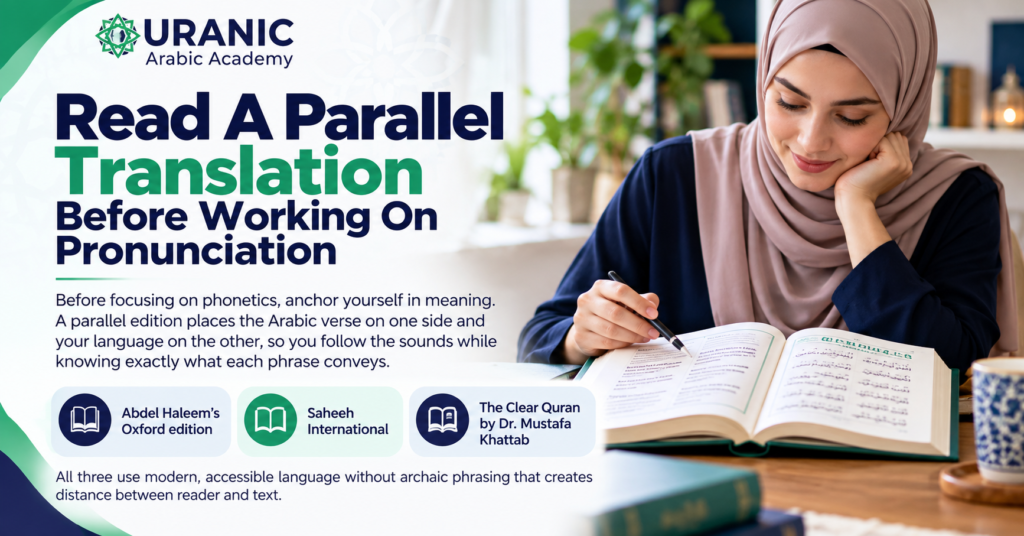
Before focusing on phonetics, anchor yourself in meaning. A parallel edition places the Arabic verse on one side and your language on the other, so you follow the sounds while knowing exactly what each phrase conveys.
Recommended English translations include Abdel Haleem’s Oxford edition, Saheeh International, and The Clear Quran by Dr. Mustafa Khattab. All three use modern, accessible language without archaic phrasing that creates distance between reader and text.
For structured study materials that go beyond standalone translations, Quranic Arabic Books lists vetted resources trusted by both Muslim and non-Muslim learners beginning their Quran reading journey.
See It in Action:
Wondering what our interactive sessions look like? Click below to peek inside a live session and watch how our expert instructors make learning Quranic Arabic accessible and engaging.
Ready to Begin Your Quranic Journey?
Start learning with professional instructors through our structured curriculum.
Book Your Free Trial3. Learn The Arabic Alphabet And Its Unique Sounds
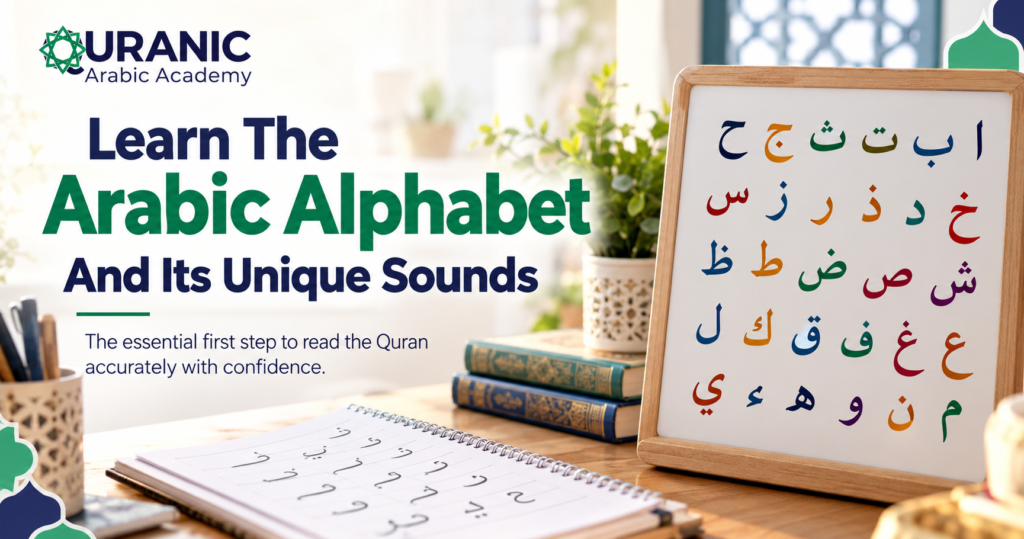
You cannot recite the Quran accurately without recognizing its letters. Arabic has 28 letters, and several produce sounds with no equivalent in English, French, German, or most South Asian languages. Skipping this foundation turns later reading practice into guessing.
For a structured path to how to Read Quranic Arabic?, letter recognition and basic vowel rules are the non-negotiable first layer, achievable through a few weeks of focused daily practice.
Two tasks define this step: learning the full alphabet in the correct sequence, and drilling the specific sounds that most challenge non-Arabic speakers.
A. Master the 28 Arabic Letters in Their Correct Sequence
Start with a chart that pairs each letter with its four written forms: isolated, initial, medial, and final. Arabic letters change shape depending on their position in a word, and reading continuously requires recognizing all four forms without hesitation.
The Quranic Arabic Alphabet is a detailed reference that maps every letter with audio examples, visual shape guides, and reading samples drawn directly from Quranic verses rather than general textbook vocabulary.
Diacritical marks, called harakat, sit above or below each letter to indicate short vowels and transform individual letters into readable words.
A dedicated resource on Quranic Arabic Diacritics covers every mark with audio examples and clear rules for how each one alters the sound beneath it.
B. Focus on the Four Sounds That Challenge Non-Arabic Speakers Most
Four Arabic letters consistently produce the most errors in non-native readers: Daad (ض), Ayn (ع), Haa (ح), and Qaaf (ق). These are pharyngeal and emphatic consonants that English, French, German, and most South Asian languages do not contain.
Daad is so phonetically unique that classical linguists named Arabic “the language of Daad” (Lughat Al-Daad). Correcting these sounds requires imitating a native speaker’s mouth and throat position; reading a phonetic description in text almost never produces accurate articulation.
For students beginning from absolute zero, Learning Quranic Arabic for Complete Beginners provides a structured course covering both letter recognition and difficult-sound drilling in one organized, sequential program.
Begin Your Quranic Arabic Journey in London

4. Start Your Reading From Juz Amma, Not From The Opening Chapter
The Quran is organized by revelation period and length, not by reading difficulty. Beginning at the first chapter places a new reader inside long, grammatically layered texts designed for an audience already fluent in classical Arabic literary style.
Juz Amma is the 30th and final section of the Quran, containing the shortest surahs; most run between 3 and 20 verses. Full vowel marking and a consistent rhythmic structure make pronunciation patterns easier to identify and repeat.
A dedicated resource on Juz Amma Quranic Studies provides surah-by-surah breakdowns, pronunciation notes, and meaning explanations that help beginners move through this section with genuine comprehension, not just phonetic repetition.
Begin specifically with Surah Al-Fatiha (7 verses), Surah Al-Ikhlas (4 verses), and Surah Al-Falaq (5 verses). These three appear in daily Muslim prayer, making abundant audio recordings, slow-recitation versions, and teacher guides available from dozens of credible sources.
Read also: How To Read Quran For Beginners? Effective Steps To Build A Solid Foundation
5. Imitate Certified Reciters Using the Talqeen Method for Maximum Accuracy
Talqeen is the classical Quranic teaching method where a teacher reads one phrase and the student repeats it immediately, matching sound, rhythm, and pause. It trains ear and voice together through direct imitation, bypassing phonetics theory entirely.
This goes beyond simple mimicking. A qualified teacher using talqeen listens for specific error categories: incorrect vowel length, wrong letter merging, and pausing in the wrong position. They correct each error before it settles into habit.
Many non-Muslim readers who rely entirely on YouTube recordings plateau quickly, because audio cannot identify which specific error you are making.
Talqeen with a live teacher, even over a video call, remains the fastest known path to accurate reading for non-native speakers.
Start Building Your Child’s Quranic Arabic Foundation Today
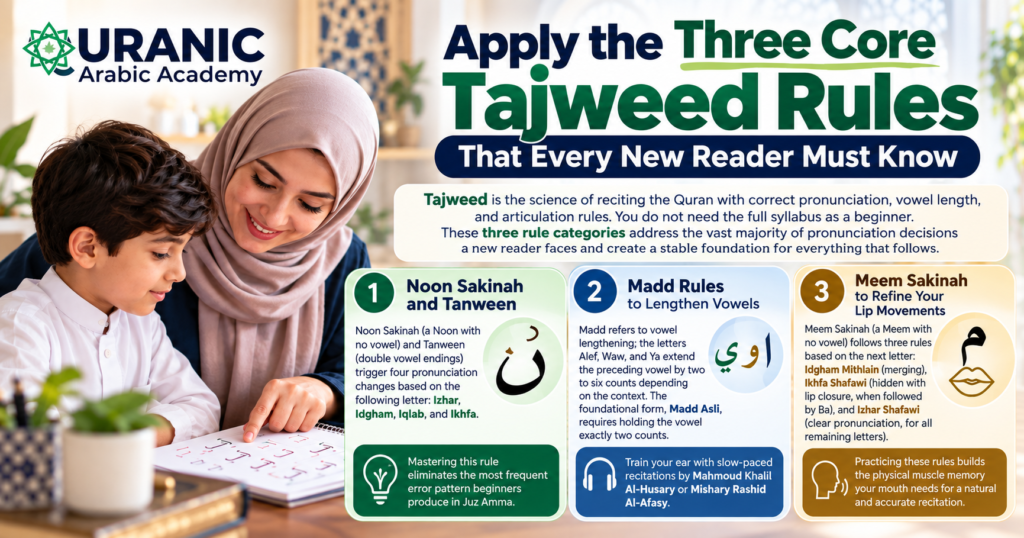
6. Apply the Three Core Tajweed Rules That Every New Reader Must Know
Tajweed is the science of reciting the Quran with correct pronunciation, vowel length, and articulation rules. It is not an advanced layer added after fluency; it is the baseline standard that separates accurate Quran reading from phonetic approximation.
You do not need the full Tajweed syllabus as a beginner. Three rule categories address the vast majority of pronunciation decisions a new reader faces in Juz Amma, and mastering them first creates a stable foundation for everything that follows.
For a complete view of the full system, Quranic Tajweed Rules provides a structured breakdown of every rule category, with audio examples and surah-specific application notes for beginner and intermediate students.

A. Follow the Rules of Noon Sakinah and Tanween
Noon Sakinah (a Noon with no vowel) and Tanween (double vowel endings at the end of a word) both trigger one of four pronunciation changes based on the following letter: Izhar (clear pronunciation), Idgham (merging), Iqlab (conversion to Meem), and Ikhfa (hidden nasalization).
Mastering Noon Sakinah alone eliminates the most frequent error pattern beginners produce in Juz Amma, because these patterns appear in nearly every surah.
A simple two-column table listing which letters trigger which rule makes this learnable within one to two focused sessions.
B. Apply the Madd Rules to Lengthen Vowels the Correct Number of Counts
Madd refers to vowel lengthening; the letters Alef, Waw, and Ya extend the preceding vowel by two to six counts depending on grammatical context. Reading a Madd letter at the same short duration as a regular vowel alters the sound and, in certain cases, the meaning of the word.
The foundational form, Madd Asli (natural elongation), requires holding the vowel exactly two counts. Train your ear with slow-paced recitations by Mahmoud Khalil Al-Husary or Mishary Rashid Al-Afasy, both of whom offer learner-specific recordings that let you track individual letter rules clearly.
C. Practice the Rules of Meem Sakinah to Refine Your Lip Movements
Meem Sakinah (a Meem with no vowel) follows three rules based on the letter that comes after it: Idgham Mithlain (merging, when followed by another Meem), Ikhfa Shafawi (hidden with lip closure, when followed by Ba), and Izhar Shafawi (clear pronunciation, for all remaining letters).
These rules directly affect lip contact and nasal airflow. Practicing them slowly, one letter pair at a time, builds the physical muscle memory your mouth needs before you attempt reading at a natural pace.
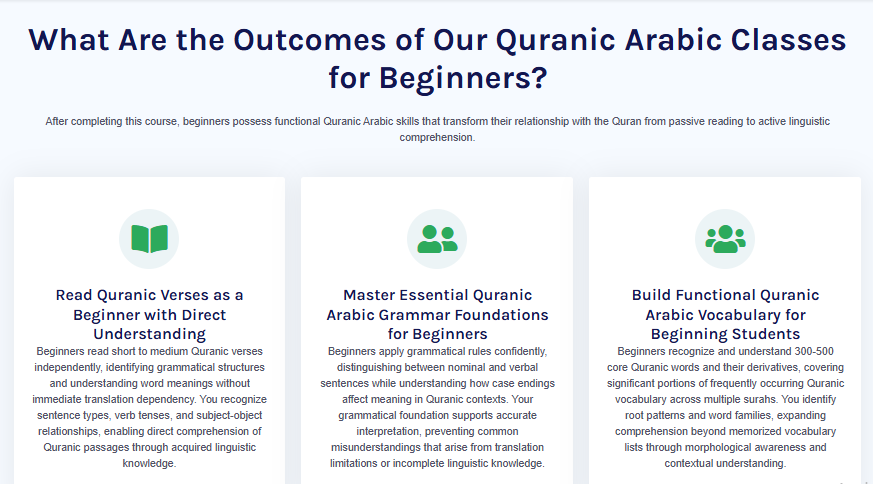
Explore the Outcomes of Our Quranic Arabic Classes for Beginners?
7. Practice Your Reading Every Day with Trusted Quranic Apps and Digital Tools
Consistency outperforms intensity in Quran reading development. Fifteen minutes of daily practice produces better results than a two-hour session once a week, because reading Arabic is a motor and auditory skill that builds through regular, spaced repetition.
Two applications stand out for non-Muslim beginners: Tarteel, which uses AI to detect and correct Tajweed errors in real time as you recite into your device, and Quran Majeed, which provides multilingual translations, variable-speed audio, and color-coded Tajweed markers overlaid on every word.
To maintain momentum between classes, How to Build a Daily Quran Routine offers a structured 15-to-20-minute daily practice template designed for learners with no prior Arabic or Islamic education background.
Quranic Arabic Academy integrates curated digital tools directly with its certified live teacher program, giving students access to self-paced app practice and scheduled teacher correction within a single structured syllabus.
Courses are tailored for international non-Muslim learners across the USA, Canada, UK, Germany, France, Australia, South Asia, Southeast Asia, and the Gulf, with flexible scheduling across all time zones.
Meet our Dedicated & Experienced Arabic and Quran Teachers.
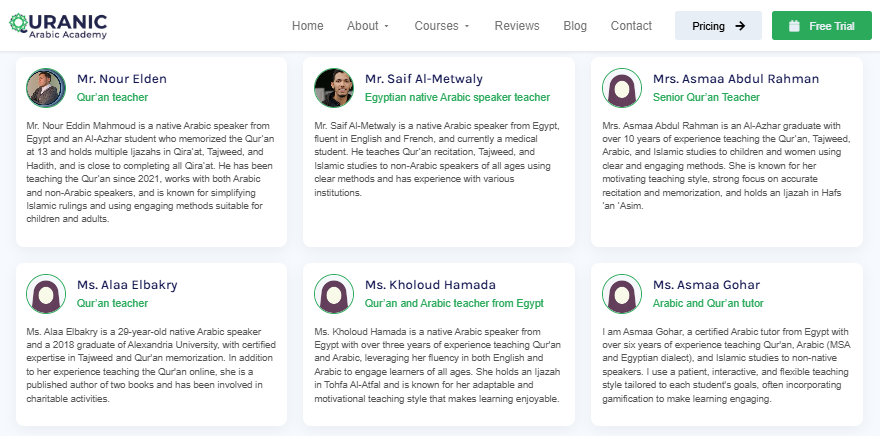
8. Train with A Qualified Quranic Teacher Through Structured Online Sessions
No application replaces a trained human ear. Online Quran classes provide a teacher who listens to your specific recitation, identifies your individual error patterns, and adjusts pace and curriculum to your progress rather than following a generic schedule.
When selecting a teacher, look for Ijazah certification (a documented chain of transmission linking the teacher’s reading back to the Prophet Muhammad through a verified sequence of scholars), proven experience with non-native adult learners, and a structured syllabus with clear progression milestones.
For learners exploring structured study paths outside traditional mosque settings, Online Quranic Studies connects students with verified programs serving international learners across North America, Europe, Asia-Pacific, and the Gulf region.
Quranic Arabic Academy offers one-on-one Quran reading courses designed specifically for non-Muslims and first-time learners. Certified native-speaking instructors guide each student from zero pronunciation knowledge to confident, accurate reading, adjusting every session to the student’s current level and pace.
Experience Our Teaching Style:
We believe in clarity and engagement. Watch these short highlights from our actual classes to see our teachers’ methodology and student interactions in real-time.
Ready to Begin Your Quranic Journey?
Start learning with professional instructors through our structured curriculum.
Book Your Free TrialUnlock The Deepest Meanings Of The Holy Text At The Quranic Arabic Academy
Ready to move beyond translations? Our specialized Quranic Arabic courses are designed to bridge the gap between reading words and truly understanding their divine context.
Whether you are an absolute beginner or looking to perfect your grammar and vocabulary, expert instructors in Quranic Arabic Academy guide you step-by-step. Witness our teaching method in action below and see how seamlessly you can connect with the language of the Quran.
Check out our top courses to start learning Quranic Arabic today:
- Quranic Arabic Classes
- Quranic Arabic Grammar Course
- Arabic Courses for Understanding the Quran
- Quranic Arabic Course for Sisters (Female)
- Quranic Arabic Course USA
- Quranic Arabic Course Canada
- Quranic Arabic Course Australia
Book your first class today and receive personalized instruction matched to your exact starting point, your learning goals, and your availability.
Conclusion
Learning how to read the Quran as a non Muslim is a structured, teachable skill with a clear pathway from start to fluency.
The eight steps are: understanding your right and intent, reading with a parallel translation, learning the Arabic alphabet and its difficult sounds, starting from Juz Amma, using the talqeen method, applying three core Tajweed rules, practicing daily with reliable apps, and training with a qualified online teacher.
The most common reason non-Muslim learners stall is starting with the wrong material; beginning inside long opening chapters without phonetic grounding, or relying on recordings with no one to correct errors. Starting from Juz Amma with a certified teacher removes all three obstacles within the first month.
For those who master these eight steps and want to advance further, how To Get Better At Reading The Quran provides targeted drills and correction techniques that take reading skill from functional to genuinely fluent.
The Quran is among the most recited and memorized texts in human history. With the right starting point, the right tools, and consistent daily effort, accurate reading is fully within reach for any motivated learner, regardless of background or prior knowledge.
Frequently Asked Questions
Can a Non-Muslim Touch a Physical Quran?
Classical scholars differ on this point. Many hold that touching the Arabic-only printed Mushaf requires ritual purity, while others permit it for educational purposes. Digital apps, translations, and bilingual editions carry no such condition and are fully accessible for reading and study.
Which Quranic Reciter Should a Non-Muslim Listen To When Learning?
For beginners, slow-paced recitations by Mahmoud Khalil Al-Husary and Mishary Rashid Al-Afasy are widely recommended by Quran teachers. Both have word-by-word recordings available that let you follow each verse without losing your place or pace.
How Long Does It Take a Non-Muslim to Learn to Read the Quran?
With 15 to 20 minutes of daily practice and one or two weekly teacher sessions, most beginners read Juz Amma surahs accurately within 3 to 6 months. Reading the full Quran fluently typically requires 1 to 2 years of consistent, structured effort.
Do I Need to Learn Full Arabic to Read the Quran?
No. Reading the Quran requires recognizing Arabic letters and applying basic pronunciation rules, not conversational Arabic fluency. Millions of Muslims worldwide read the Quran accurately every day without speaking Arabic as a daily language.
What Is the Best Surah for a Non-Muslim to Start Reading?
Surah Al-Fatiha is the universal starting point for beginner readers. It is 7 verses long, fully documented in audio at every recitation speed, and the most frequently taught surah in beginner Quran classes across all traditions worldwide.
Is It Disrespectful for a Non-Muslim to Read the Quran?
Scholars consistently hold that reading the Quran with genuine curiosity and sincere respect is not only permitted but encouraged. The Quran addresses all of humanity in many of its verses, and respectful engagement with its text, regardless of faith background, is considered a legitimate and positive act of inquiry.





Leave a Reply