 Quran
Quran
Millions of Muslims worldwide, ask how to read and understand Quran, either from the United States, the UK to Germany, Australia, South Asia, Southeast Asia, or the Gulf.
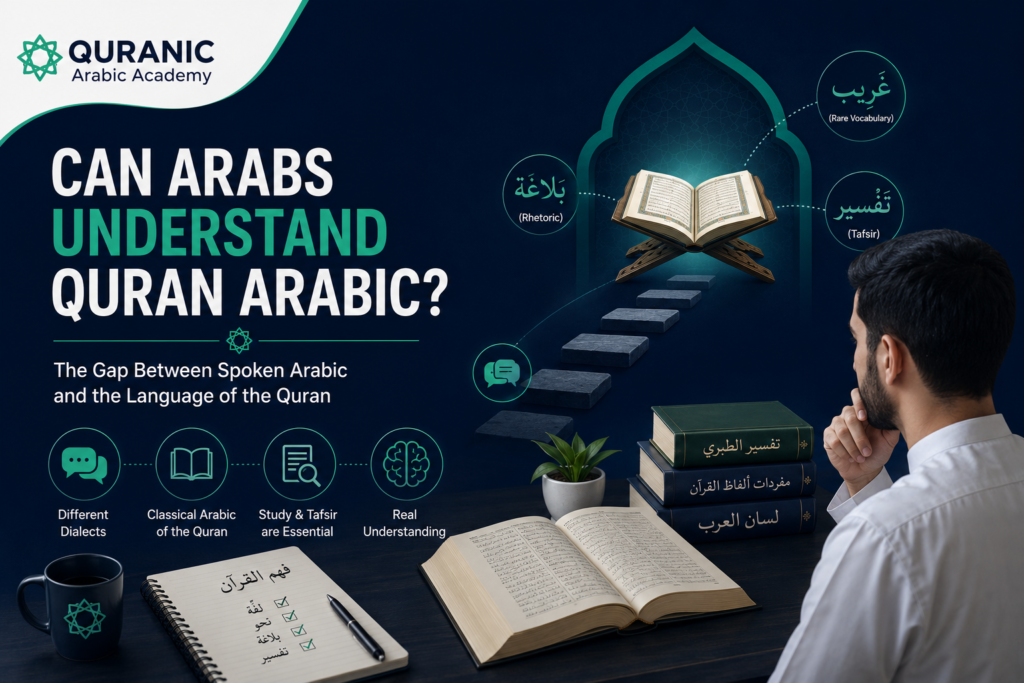
They share one deep desire: to move beyond reciting the Quran to actually understanding it. The words feel familiar, but the meaning stays out of reach.
This gap between recitation and comprehension is one of the most common struggles in Quran learning today. The encouraging truth is that it is entirely solvable when the right steps are followed in the right sequence.
This guide delivers 8 proven, actionable steps on how to read and understand Quran, drawn from classical Islamic scholarship, modern educational practice, and the experience of qualified teachers serving students across the globe.

1. Learn How To Read And Understand Quran By Mastering The Arabic Letters First
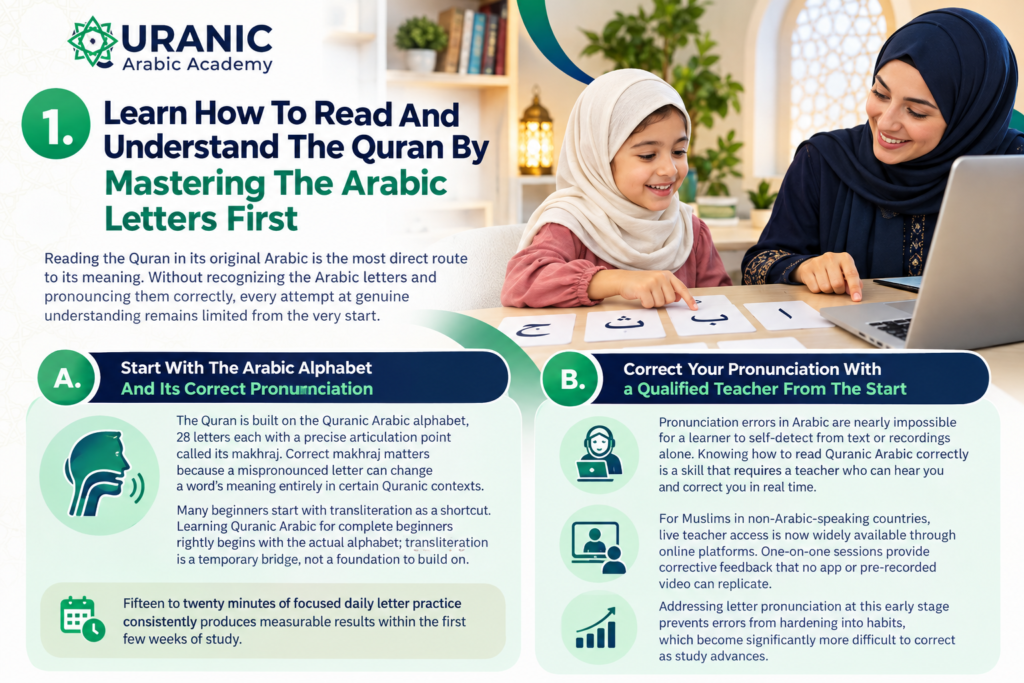
Reading the Quran in its original Arabic is the most direct route to its meaning. Without recognizing the Arabic letters and pronouncing them correctly, every attempt at genuine understanding remains limited from the very start.
A. Start With The Arabic Alphabet And Its Correct Pronunciation
The Quran is built on the Quranic Arabic alphabet, 28 letters each with a precise articulation point called its makhraj. Correct makhraj matters because a mispronounced letter can change a word’s meaning entirely in certain Quranic contexts.
Many beginners across the USA, UK, and Australia start with transliteration as a shortcut. Learning Quranic Arabic for complete beginners rightly begins with the actual alphabet; transliteration is a temporary bridge, not a foundation to build on.
Fifteen to twenty minutes of focused daily letter practice consistently produces measurable results within the first few weeks of study.
B. Correct Your Pronunciation With A Qualified Teacher From The Start
Pronunciation errors in Arabic are nearly impossible for a learner to self-detect from text or recordings alone. Knowing how to read Quranic Arabic correctly is a skill that requires a teacher who can hear you and correct you in real time.
For Muslims in non-Arabic-speaking countries, live teacher access is now widely available through online platforms. One-on-one sessions provide corrective feedback that no app or pre-recorded video can replicate.
Addressing letter pronunciation at this early stage prevents errors from hardening into habits, which become significantly more difficult to correct as study advances.
Start Building Your Child’s Quranic Arabic Foundation Today

2. Apply Tajweed Rules So Your Recitation Honors The Quran’s Precise Standard
Once the Arabic letters are clear, the next step is reciting them according to tajweed. Tajweed is the science of reciting the Quran exactly as the Prophet, peace be upon him, received it from Jibreel.
A. Understand What Tajweed Covers And Why It Cannot Be Skipped
Studying Quranic tajweed rules reveals that tajweed is not about sounding beautiful; it is a set of precise rules covering elongation, stopping points, letter merging, and the proper weight of specific sounds.
The Quran commands: “Recite the Quran with measured recitation” (Al-Muzzammil, 73:4). Understanding what is Quranic recitation as a disciplined science, not a personal style choice, is the first shift every serious learner must make.
Attempting to understand Quranic meaning without correct recitation is like reading a sentence while mispronouncing half its words; the message distorts before it is ever received.
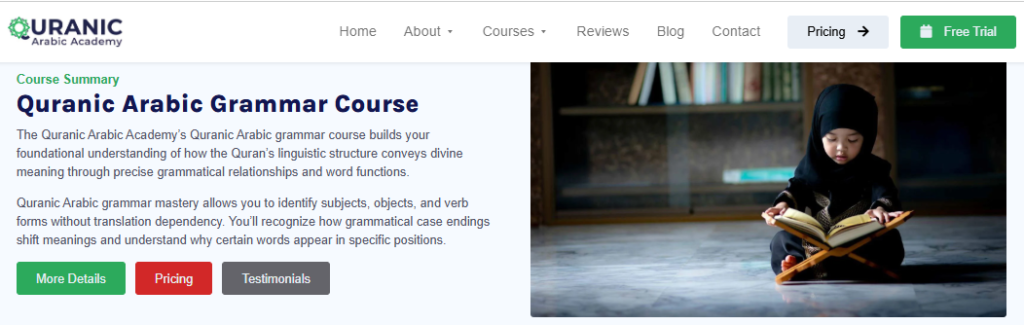
Transform Your Quran Understanding Through Quranic Arabic Grammar Mastery
B. Build Tajweed Skills In A Structured And Progressive Sequence
A beginning student does not need to master every tajweed rule before reading meaningfully. The foundational rules covering madd (elongation), noon sakinah, meem sakinah, and stopping marks address the vast majority of everyday recitation situations.
Understanding Quranic Arabic diacritics, the small marks above and below letters that govern vowel sounds and pronunciation length, is a parallel step that reinforces tajweed learning significantly.
Many Gulf residents and South Asian Muslims grow up hearing beautiful recitation from childhood. Hearing tajweed correctly and being able to produce it are two distinct and separately learnable skills.
3. Choose A Reliable Translation That Matches Your Level And Reading Purpose
A clear English translation is the most immediate window into Quranic meaning for non-Arabic speakers. Deciding to learn Arabic to understand the Quran is the long-term goal, but a good translation is the practical bridge that serves you while that skill develops.
The most widely recommended English translations include Saheeh International, the Pickthall translation, and “The Clear Quran” by Dr. Mustafa Khattab.
“The Clear Quran” uses contemporary, accessible English that many Muslims in Western countries find easiest to follow without losing scholarly accuracy.
Building familiarity with the most common words in the Quran helps any reader develop an intuitive sense of Quranic language, even before formal Arabic study begins.
When selecting a translation, also verify that the translator was a qualified Islamic scholar and that the language level matches your reading comfort.
See It in Action:
Wondering what our interactive sessions look like? Click below to peek inside a live session and watch how our expert instructors make learning Quranic Arabic accessible and engaging.
Ready to Begin Your Quranic Journey?
Start learning with professional instructors through our structured curriculum.
Book Your Free Trial4. Study Tafsir Alongside Each Section To Access The Quran’s Deeper Meaning
A translation gives you the words. Quranic exegesis (tafsir) gives you the world behind the words. This distinction is essential for anyone who wants to understand the Quran beyond its surface level.
A. Understand What Tafsir Contains And How To Use It Effectively
Engaging with Quranic hermeneutics reveals that scholarly interpretation draws on classical Arabic analysis, the reasons for revelation (asbab al-nuzul), the hadiths of the Prophet, and the recorded statements of the Companions.
Reading a verse alongside its tafsir reveals what no translation can convey: why a specific Arabic word was chosen over its synonym, what the historical context of revelation was, and how classical scholars applied the verse to legal and spiritual questions.
For English-speaking students globally, accessible Quranic tafsir resources include the abridged “Tafsir Ibn Kathir,” “In the Shade of the Quran” by Sayyid Qutb, and “Tafsir Al-Sa’di,” now available in translation. Beginning with one surah and reading its full tafsir before moving forward is a proven and efficient approach.
Join Quranic Arabic Academy’s Leading Quranic Arabic Course in UAE

B. Read Tafsir In Sequential Order To Preserve The Quran’s Thematic Structure
A common mistake among motivated beginners is jumping between surahs, reading one verse’s explanation, then skipping to a different surah. This breaks the contextual flow that is essential to genuine Quranic understanding.
The Quran is a coherent text built on Quranic linguistics, with internal cross-references, recurring arguments, and narrative structures that span multiple surahs. Reading tafsir in sequence preserves this architecture and makes the connections meaningful and visible.
Quranic Arabic Academy’s expert instructors guide students through this sequential, layered approach, providing essential context at every stage.
Students from the UK, Australia, France, and Southeast Asia have used this method to move from surface reading to deep, applied comprehension.
5. Practice Tadabbur, The Method Of Deep Reflection The Quran Itself Commands
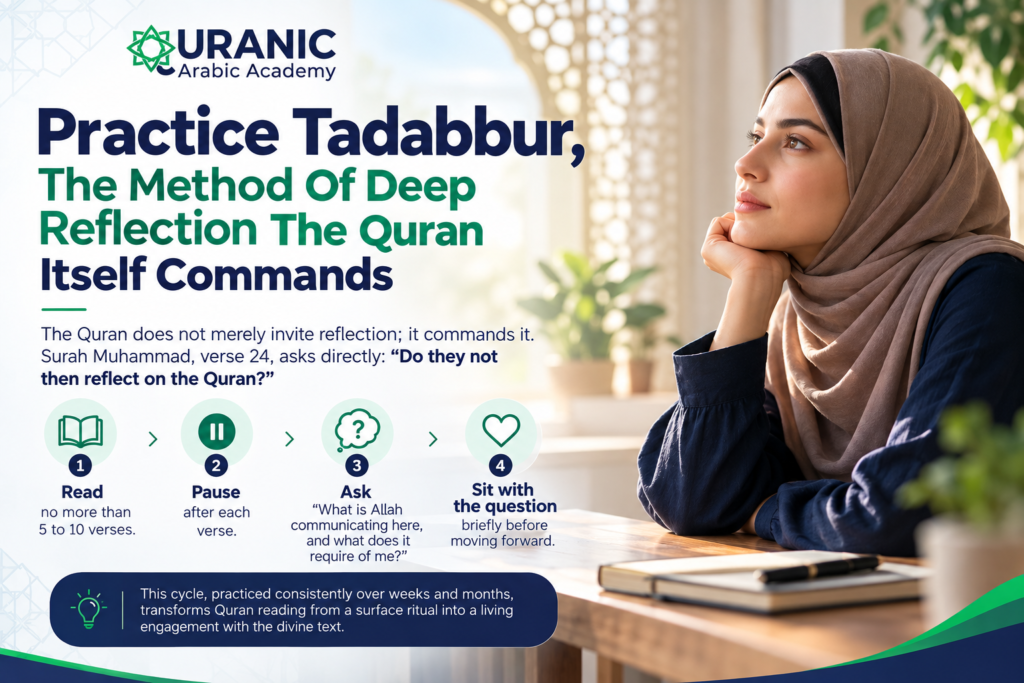
The Quran does not merely invite reflection; it commands it. Surah Muhammad, verse 24, asks directly: “Do they not then reflect on the Quran?” Tadabbur, which is sustained and intentional contemplation of Quranic meaning, is a Quranic obligation, not an optional spiritual enhancement.
Incorporating Quranic reflections into your daily practice follows a method described by Al-Harith Al-Muhasibi, a foundational scholar of Islamic spirituality.
His approach involved quieting internal distraction, setting a clear intention, and reading slowly enough for each verse to be genuinely weighed and experienced.
Modern research on deep reading confirms this slower, intentional method produces significantly stronger comprehension and retention than passive reading.
Exploring Quranic verses about knowledge reveals that the Quran repeatedly links reading with reflection and then with action.
The practical method of tadabbur works as follows: read no more than 5 to 10 verses; pause after each verse; ask “What is Allah communicating here, and what does it require of me?”.
Then sit with that question briefly before moving forward. This cycle, practiced consistently over weeks and months, transforms Quran reading from a surface ritual into a living engagement with the divine text.

6. Build A Daily Reading Habit That Fits Your Real Life And Actual Schedule
The benefits of reading the Quran daily accumulate through consistent return, not through occasional long sessions. The most critical variable in Quran comprehension is not how much you read in one sitting; it is how reliably you come back each day.
Knowing how to build a daily Quran routine means choosing one specific, protected time and treating it as non-negotiable. Research in habit formation, alongside centuries of Islamic scholarly observation, confirms that reflecting on one to two pages daily for one full year produces deeper understanding than reading large amounts sporadically across the same period.
For Muslims with demanding professional schedules across the USA, UK, Germany, Canada, and France, even 10 to 15 focused minutes after Fajr is sufficient to build genuine, accumulating Quranic comprehension.
The time after Fajr works especially well because the mind is fresh and the day’s distractions have not yet begun.
Quranic Arabic Academy designs its programs specifically for students with real-world schedules across multiple time zones, from the USA and Gulf countries to South Asia, Southeast Asia, and Europe.
Students can also access free Quranic Arabic resources on the Academy’s blog to supplement live sessions and reinforce daily learning between classes.
7. Connect Every Verse You Read Directly To Your Current Life And Circumstances
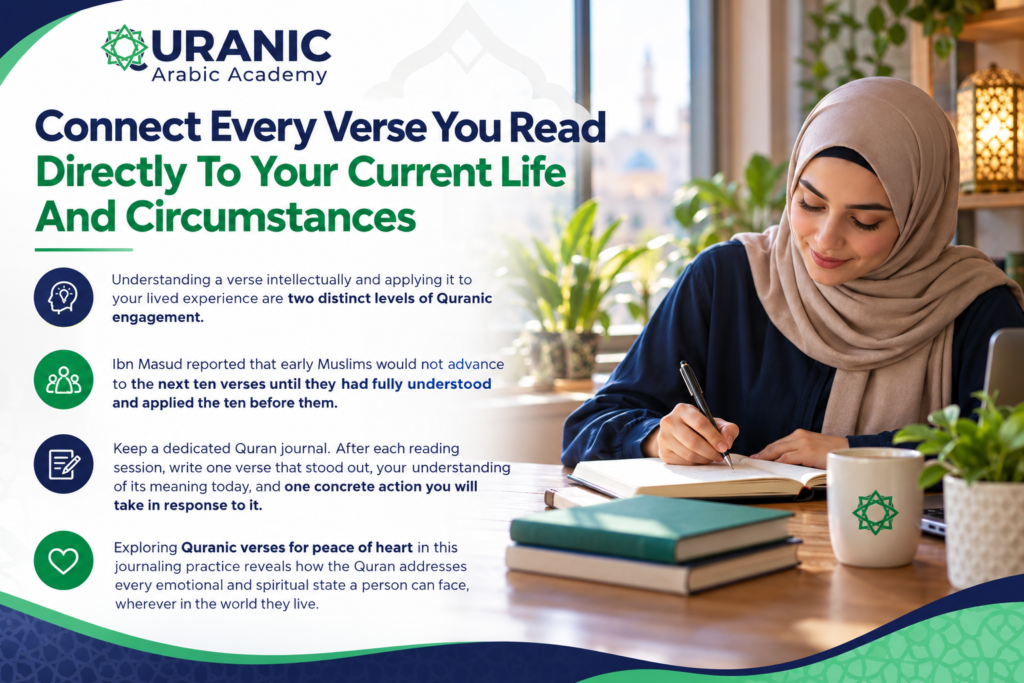
Understanding a verse intellectually and applying it to your lived experience are two distinct levels of Quranic engagement. Practicing Quranic tarbiyah, the Quranic approach to personal development and character formation, is what takes a learner from comprehension to genuine transformation.
Ibn Masud, one of the most eminent Companions of the Prophet, reported that early Muslims would not advance to the next ten verses until they had fully understood and applied the ten before them.
This methodology made Quranic guidance specific, personal, and immediately actionable rather than abstract and theoretical.
Keeping a dedicated Quran journal makes this connection practical. After each reading session, write one verse that stood out, your understanding of its meaning today, and one concrete action you will take in response to it.
Exploring Quranic verses for peace of heart in this journaling practice reveals how the Quran addresses every emotional and spiritual state a person can face, wherever in the world they live.
8. Find A Qualified Teacher Who Can Guide Your Entire Learning Journey
Every serious discipline maintains a master-to-student transmission tradition for a reason. The transmission of the Quran itself, the isnad system, is built entirely on verified teacher-to-student learning across 14 centuries.
This model endures because some things cannot be learned correctly from books or applications alone.
Sound Quranic education requires three things no self-study resource fully replaces: real-time correction of pronunciation errors before they become habits, answers to the specific questions your individual journey raises, and a structured progression that prevents the confusion typical of unsupported self-study.
Quranic Arabic Academy connects students globally with experienced, certified Quran teachers through live, one-on-one sessions. Their progressive curriculum covers online Quranic studies in recitation, tajweed, tafsir, and Quranic Arabic, built for students from complete beginner to advanced level.
Whether you are in Canada, Germany, Southeast Asia, or across the Gulf, qualified guidance is now available directly from your home.
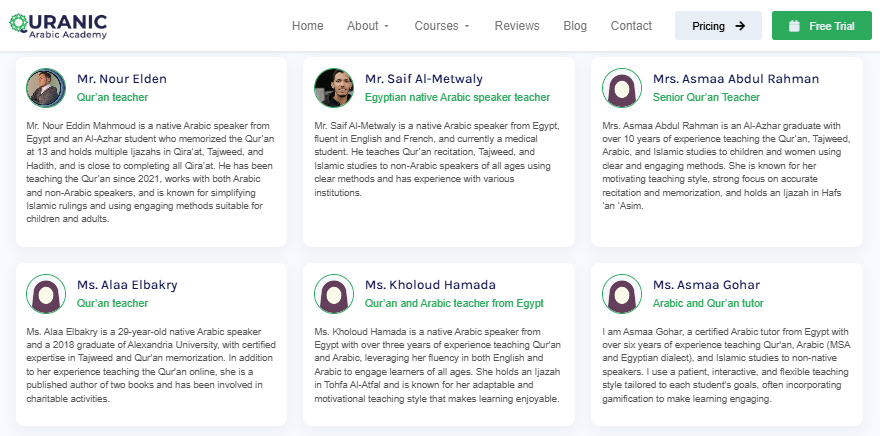
Meet our Dedicated & Experienced Arabic and Quran Teachers.
Experience Our Teaching Style:
We believe in clarity and engagement. Watch these short highlights from our actual classes to see our teachers’ methodology and student interactions in real-time.
Ready to Begin Your Quranic Journey?
Start learning with professional instructors through our structured curriculum.
Book Your Free TrialStart Today And Transform Your Relationship With The Quran
If you are ready to move from reciting words to understanding their meaning, Quranic Arabic Academy gives you the tools, the teachers, and the structure to make that shift real.
Thousands of Muslims across the USA, UK, Canada, Australia, Germany, France, South Asia, Southeast Asia, and the Gulf have already taken this step through their programs.
Their expert teachers design personalized learning plans covering every stage of the journey, from Arabic letters through to tafsir and applied reflection.
Whether you are a complete beginner or returning to the Quran after years away, the path to understanding starts with a single decision: choosing a program designed around your actual level and schedule.
How to get better at reading the Quran is a question Quranic Arabic Academy has helped thousands of students answer through structured, teacher-led programs with flexible scheduling for every time zone.
Check out our top courses to start learning Quranic Arabic today:
- Quranic Arabic Course for Beginners
- Online Quranic Arabic Courses for Advanced Learners
- Arabic Courses for Understanding the Quran
- Quranic Arabic Course for Sisters (Female)
- Quranic Arabic Course for Kids
- Quranic Arabic Course London
- Quranic Arabic Course USA
- Quranic Arabic Course Canada
Book your free trial session today and experience what learning the Quran
Conclusion
The journey of how to read and understand Quran is not a single act; it is a lifelong practice built from consistent, correctly sequenced steps.
Mastering the Arabic letters, building correct recitation through tajweed, accessing meaning through translation and tafsir, practicing tadabbur, building a daily habit, applying verses to real life, and learning under qualified guidance: each step strengthens the one that follows it.
For Muslims across the United States, the United Kingdom, Germany, France, Australia, Canada, South Asia, Southeast Asia, and the Gulf, the Quran is the same divine text.
What separates those who understand it deeply from those who remain at the level of recitation is not intelligence or devotion; it is methodology and access to the right guidance.
Pursuing the rewards of reading the Quran goes far beyond spiritual merit. It opens a direct conversation between the believer and their Creator, one verse at a time.
With these eight steps and the right teacher, genuine Quranic comprehension is not a distant aspiration; it is a practical and achievable goal for any Muslim ready to begin.
Frequently Asked Questions
How Long Does It Take To Read And Understand The Quran Properly?
A complete beginner typically reaches confident basic recitation with tajweed within 6 to 12 months of consistent, guided study. Meaningful comprehension of meaning generally develops over 2 to 3 years of daily practice. Individual starting level and daily consistency are the most significant factors in determining the timeline.
Can I Understand The Quran Without Learning Arabic?
A reliable English translation and a good tafsir give meaningful access to the Quran’s core message without Arabic knowledge. However, full comprehension of the Quran’s precision, layered meanings, and eloquence requires some level of Quranic Arabic. Even a basic Quranic vocabulary significantly deepens your understanding with every reading session.
What Is The Best Way To Start Understanding The Quran As A Complete Beginner?
Begin with the Arabic letters and their correct pronunciation before attempting to read full verses. Pair a clear English translation, such as “The Clear Quran” by Dr. Mustafa Khattab, with accessible tafsir for each surah you study. Reading a small daily portion with focused reflection produces far better results than long, irregular sessions.
Is It Acceptable To Use Only An English Translation During Quran Study?
Reading the Quran in translation is valid, beneficial, and encouraged by scholars for non-Arabic speakers. The recitation performed in prayer must remain in Arabic, which is why learning Arabic recitation alongside the translation is the recommended combined approach. Using both together produces the strongest comprehension outcomes for most learners.
How Do I Stay Motivated When Quran Study Becomes Difficult?
Motivation follows consistent structure rather than variable emotional peaks. Set a fixed daily time, even 10 minutes, and protect it without exception.
Tracking visible progress, connecting with a teacher or study community, and regularly returning to your intention of closeness to Allah sustain commitment more reliably than emotional resolve alone.
Do I Need A Teacher, Or Can I Learn To Understand The Quran By Myself?
Self-study resources are useful supplements, but they cannot replace a qualified teacher for most learners, especially beginners.
A teacher catches pronunciation errors you cannot hear yourself, answers the specific questions your personal learning raises, and maintains the accountability that keeps self-study from stalling.
Starting with a qualified teacher from the outset is the single most efficient decision most students can make.




Leave a Reply