 Quran
Reading the Quran correctly requires three things: knowing each letter’s articulation point, understanding how surrounding letters affect it, and knowing how long each sound lasts.
The word-by-word method solves all three simultaneously. You hear a word, read it, confirm the Tajweed rules, and only then move to the next one.
The eight steps below follow the sequence certified Tajweed instructors use with beginners and adult learners, from the first Arabic letter to surah recitation with accurate Tajweed.
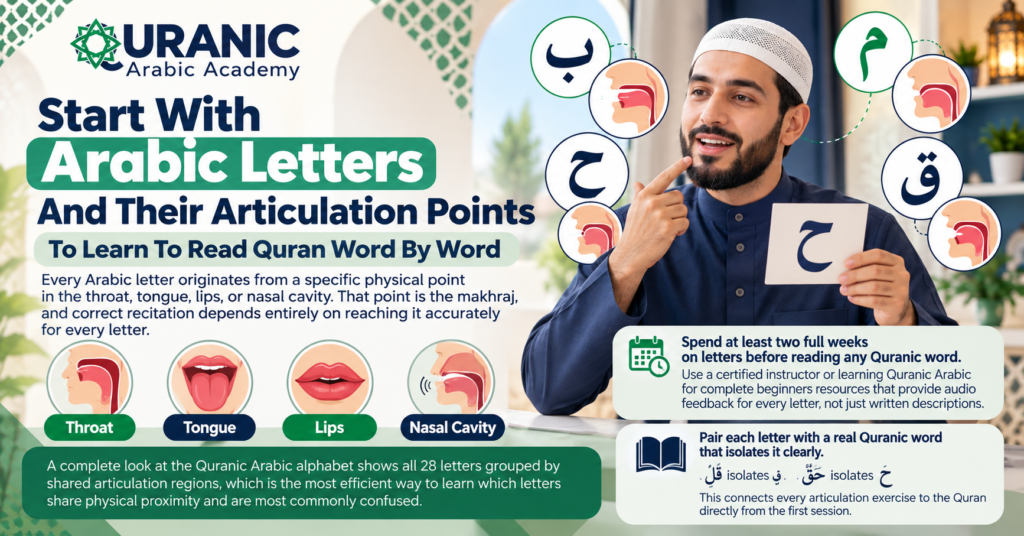
1. Start With Arabic Letters And Their Articulation Points To Learn To Read Quran Word By Word
Every Arabic letter originates from a specific physical point in the throat, tongue, lips, or nasal cavity. That point is the makhraj, and correct recitation depends entirely on reaching it accurately for every letter.
A complete look at the Quranic Arabic alphabet shows all 28 letters grouped by shared articulation regions, which is the most efficient way to learn which letters share physical proximity and are most commonly confused.
Spend at least two full weeks on letters before reading any Quranic word. Use a certified instructor or learning Quranic Arabic for complete beginners resources that provide audio feedback for every letter, not just written descriptions.
Pair each letter with a real Quranic word that isolates it clearly.
قُلْ isolates ق.
حَقٌّ isolates ح. This connects every articulation exercise to the Quran directly from the first session.
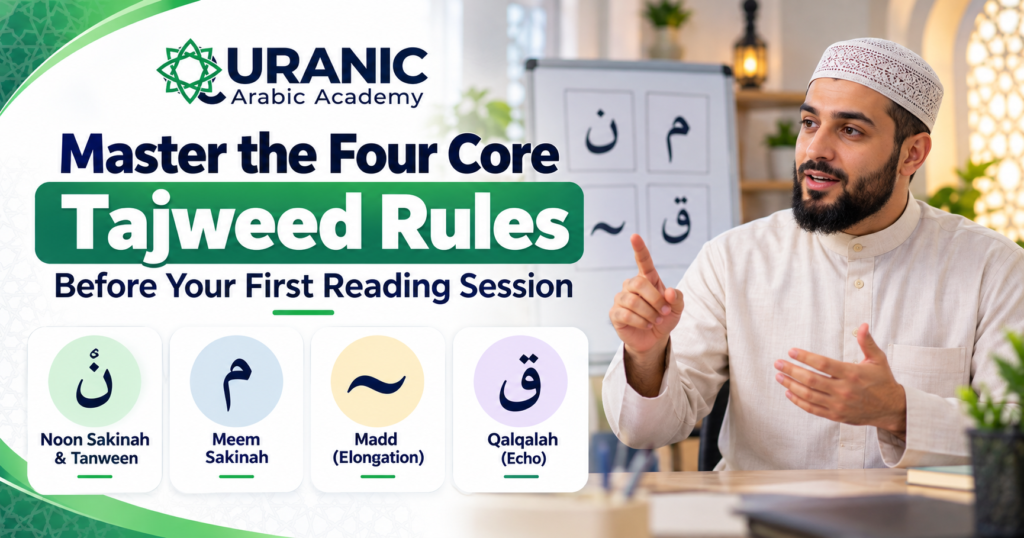
2. Master The Four Core Tajweed Rules Before Your First Reading Session
Understanding Quranic tajweed rules does not mean memorizing the entire science before you begin. You need the four rule groups that appear in nearly every surah of the Quran.
Below is a summary of the four foundational rules, what triggers each, and what you do when each applies.
| Tajweed Rule | Trigger | What You Do |
| Noon Sakinah And Tanween | Noon sakinah or tanween before specific letters | Apply Izhar, Idgham, Ikhfa, or Iqlab |
| Meem Sakinah | Meem sakinah before ba or meem | Apply Izhar Shafawi, Ikhfa Shafawi, or Idgham Shafawi |
| Madd (Elongation) | Long vowel letters under specific conditions | Hold the sound for 2, 4, or 6 counts |
| Qalqalah (Echo) | ب ج د ط ق with sukoon | Add a distinct bouncing echo to the letter |
A. The Rules Of Noon Sakinah And Tanween
These rules produce four outcomes depending on which letter follows the noon or tanween. Izhar: pronounce the noon clearly, applied before six throat letters. Idgham: merge it into the next letter with nasal resonance, applied before six specific letters.
Ikhfa: conceal the noon partially with a nasal hum, applied before 15 specific letters. Iqlab: convert the noon to a meem sound, applied only before ba.
Practicing these four outcomes using 20 words from Surah Al-Baqarah builds more lasting retention than studying the theory in isolation.
B. The Rules Of Madd And Qalqalah
Madd rules determine how long each vowel sound lasts. Natural Madd lasts two counts. Connected Madd (Madd Muttasil) lasts four to five counts. Separated Madd (Madd Munfasil) ranges from two to five counts depending on the recitation path chosen.
A deeper study of Juz Amma Quranic studies shows how frequently Qalqalah positions appear in the shortest surahs, making Juz Amma the ideal training ground for this rule before moving to longer chapters.
See It in Action:
Wondering what our interactive sessions look like? Click below to peek inside a live session and watch how our expert instructors make learning Quranic Arabic accessible and engaging.
Ready to Begin Your Quranic Journey?
Start learning with professional instructors through our structured curriculum.
Book Your Free Trial3. Use A Word-By-Word Quran App As Your Daily Practice Tool
A review of the best Quranic apps shows that several are designed specifically for the word-by-word method, combining text, audio, translation, and color-coded Tajweed in one interface so you never need to switch resources mid-session.
The table below compares the four most widely recommended options for different learner types and goals.
| App | Best For | Key Feature |
| Quran.com | All learner levels | Free word-by-word text with translation and Tafsir |
| Greentech Quran App | Intermediate learners | 65+ languages, multiple reciters, color-coded Tajweed |
| Nour Al-Bayan | Beginners and children | Letter-level pronunciation on the Baghdadi method |
| Electronic Quran Teacher | Pronunciation training | Single-word audio repeat up to five times |
Students who want structured practice alongside expert feedback can combine these apps with a certified instructor for real-time correction that no app alone can replicate.
A guide on how to build a daily Quran routine recommends a 15 to 20 minute session structured as five minutes of review and ten minutes of new material, which produces more consistent skill gains than occasional longer sessions.
Start Your Journey with the Book of Allah

4. Listen To Expert Reciters For At Least Ten Minutes Every Day
The benefits of reading the Quran daily extend beyond spiritual reward; deliberate daily listening trains your ear to recognize correct recitation before your tongue can produce it reliably. Following each word closely, rather than playing audio passively, accelerates that recognition faster than any other single habit.
Sheikh Muhammad Siddiq Al-Minshawi is consistently recommended by Tajweed instructors for beginners because his measured pace and precise articulation make every makhraj clearly audible without any compression or rushing.
Choose one surah and listen to it every day for a full week before moving to another. Track the words in your Mushaf as you listen. After a week, record your own recitation of the same surah and compare it directly to the reciter’s audio.

Read also: How To Read The Quran With Beautiful Voice? 9 Proven Steps
5. Practice With A Color-Coded Tajweed Mushaf
Reading Quranic symbols explained alongside your color-coded Mushaf practice helps you understand what each mark represents before applying it. Green marks Qalqalah letters. Red marks Ghunna positions. Blue or gold marks Madd letters.
In word-by-word study, the color-coding is especially effective because it confirms the rule in the same moment you read the word. You identify it visually and apply it immediately, training rules as reflexes rather than as deliberate calculations.
A structured approach that also covers Quranic Arabic diacritics works well here: focus exclusively on green letters in the first week of a new surah, add the red markers in week two, and by week three apply all colors simultaneously until the rules function without conscious effort.
Students who combine color-coded Mushaf practice with certified instructor correction eliminate their most persistent pronunciation errors significantly faster than self-study alone.
Explore why Sisters Choose The Quranic Arabic Academy for Quranic Arabic Studies?

6. Recite Each Word Slowly Until It Matches The Reciter’s Audio Exactly
Understanding what is Quranic recitation? at its core reveals that Tarteel, the measured pace commanded in surah Al-Muzzammil (73:4), is not a beginner’s technique; it is the correct pace at every level of recitation skill.
The rule certified Tajweed teachers apply consistently: never advance to the next word until the current word sounds identical to the reciter’s audio. This often means repeating one word 15 to 20 times. That is accurate learning, not slow learning.
Record your recitation every two weeks. Listen specifically for three error types: letters that merge when they should stay separate, Madd sounds held shorter than required, and Qalqalah letters that lose their echo.
These three account for the majority of Tajweed mistakes found in self-study recitation.
7. Begin Your Practice With Short Surahs From Juz Amma
Juz Amma contains the shortest surahs in the Quran and the verses most frequently recited in daily prayer. Starting here gives you the highest repetition frequency in the shortest possible time.
Studying the most common words in the Quran reveals that many high-frequency terms appear repeatedly across Juz Amma, meaning word-by-word mastery here gives you immediate recognition in multiple places across the Quran, not only in the surahs you practiced.
Surah Al-Fatiha, Al-Ikhlas, Al-Falaq, and An-Nas appear in every prayer cycle. Mastering these four word by word means every prayer actively reinforces your recitation, creating a built-in daily repetition loop that accelerates progress beyond what additional practice sessions alone could add.
Once you recite these four surahs accurately and confidently from memory, move to Al-Kawthar, Al-Asr, and Al-Kafirun. Each introduces new Tajweed scenarios while remaining short enough to master completely within one to two weeks.
Transform Your Quranic Understanding Through USA-Based Online Arabic Instruction

8. Enroll In An Online Quran Course With A Certified Teacher
Apps and color-coded Mushafs correct the errors you can already detect. A certified teacher corrects the errors you cannot: the articulation habits practiced so many times they sound correct to you.
For students interested in online Quranic studies, verifying an instructor’s Ijazah before enrolling is essential.
An Ijazah is a continuous chain of certified recitation transmission connecting the teacher’s reading directly back to the Prophet Muhammad, peace be upon him, and it guarantees the method is rooted in authenticated knowledge.
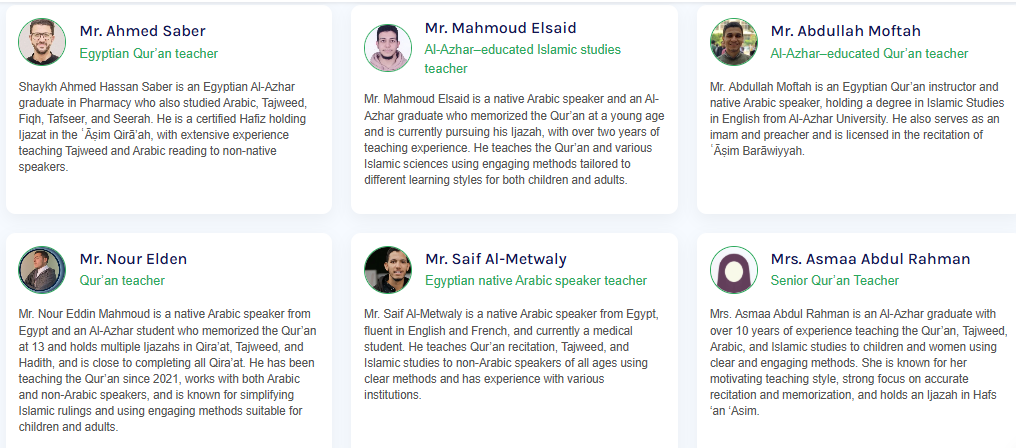
Quranic Arabic Academy offers online Quran reading courses with Ijazah-holding instructors who specialize in word-by-word recitation for both children and adults.
A. What To Look For In A Certified Quran Teacher
A Tajweed-certified instructor focuses specifically on pronunciation accuracy and rule application. A Hifz instructor focuses on memorization volume. These are different specializations, and for word-by-word reading, Tajweed certification is the critical qualification.
Ask for a trial session and request correction of at least three articulation points during it. If a certified teacher finds no errors in a beginner’s recitation, their correction standard may not match the precision word-by-word reading requires.
Confirm the instructor’s Ijazah covers the same recitation path you are learning (most commonly Hafs from Asim). Corrections based on a different path may conflict with your Mushaf’s markings.
B. How A Structured Online Course Accelerates Word-By-Word Progress
A structured course adds the element self-study consistently lacks: a correction loop. Scheduled sessions create regularity. Instructor feedback creates a cycle of error, correction, and confirmed improvement that independent practice alone cannot replicate.
For adult learners, choosing to learn Quran online removes the logistical barriers of attending a physical class. Study happens on your schedule with a certified instructor who tracks your specific error patterns session by session.
The Academy’s curriculum takes students from first letters through full Juz recitation with accurate Tajweed, in a sequence proven with thousands of learners across more than 30 countries.
Experience Our Teaching Style:
We believe in clarity and engagement. Watch these short highlights from our actual classes to see our teachers’ methodology and student interactions in real-time.
Ready to Begin Your Quranic Journey?
Start learning with professional instructors through our structured curriculum.
Book Your Free TrialStart Your Word-By-Word Quran Journey With Certified Expert Guidance Today
Every incorrectly pronounced word is a habit. Every correctly confirmed word, verified by a certified teacher, is a better one.
The path from struggling with individual letters to reciting full surahs with accurate Tajweed has been completed by thousands of students with the right structure.
Join Quranic Arabic Academy today for personalized, word-by-word Quran instruction from certified Ijazah-holding teachers. Book your free trial session and begin building recitation accuracy that lasts.
Check example of the courses of Quranic Arabic Academy:
- Quranic Arabic Course for Kids
- Online Quranic Arabic Classes for Adults
- Quranic Arabic Course UK
- Quranic Arabic Course London
- Quranic Arabic Classes
- Quranic Arabic Course for Beginners
- Online Quranic Arabic Courses for Advanced Learners
- Quranic Arabic Grammar Course
Book Your Free Trial at The Quranic Arabic Academy

Conclusion
A resource like how to get better at reading the Quran confirms what certified instructors see consistently: students who improve fastest follow a fixed sequence rather than jumping between techniques.
Letters and makhraj come first because every rule depends on correct sounds. Tajweed rules come second because they govern how letters interact. Tools, deliberate listening, and a color-coded Mushaf build daily habits. A certified teacher confirms everything by catching the errors self-study and apps cannot detect.
Fifteen focused minutes of word-by-word practice daily, combined with regular certified teacher feedback, produces more accurate recitation in three to six months than years of uncorrected self-directed repetition.
Frequently Asked Questions
How Long Does It Take To Learn To Read Quran Word By Word?
Most adult beginners achieve accurate recitation of simple surahs within three to six months of daily structured practice. Full Quran proficiency with correct Tajweed typically takes 12 to 24 months, depending on daily consistency and the frequency of certified teacher feedback.
Can I Learn To Read Quran Word By Word Without A Teacher?
Apps and color-coded Mushafs build strong foundations but cannot replace certified teacher feedback for makhraj correction. Self-study often produces confident recitation with undetected errors.
A certified teacher identifies specifically what apps miss: articulation habits that sound correct to the student.
What Is The Best Starting Surah For A Complete Beginner?
Start with Surah Al-Fatiha using a word-by-word app alongside a certified instructor. Its 29 words cover a broad range of letters and include several Tajweed rules, making it the most efficient first surah for pronunciation training and daily prayer use simultaneously.
Which App Is Best For Word-By-Word Quran Reading?
Quran.com is the most accessible free option for all levels. The Electronic Quran Teacher app suits pronunciation training with single-word repetition up to five times.
Nour Al-Bayan is recommended for children and complete beginners. Greentech Quran App is best for intermediate learners wanting multiple reciters and language options.
Do I Need To Learn All Tajweed Rules Before Starting?
No. The four foundational groups (Noon Sakinah and Tanween, Meem Sakinah, Madd, and Qalqalah) are sufficient to begin productive word-by-word reading. These rules appear in nearly every surah. The remaining rules are learned naturally as your reading progresses.
What Makes Word-By-Word Reading Different From Standard Verse Reading?
Word-by-word reading treats each word as a confirmed checkpoint before you advance. Standard verse reading groups words together, building pace but allowing pronunciation errors to pass undetected.
Word-by-word reading is slower initially and produces significantly more accurate long-term recitation.







Leave a Reply