 Learn Quranic Arabic
Millions of Muslims worldwide want to learn how to read Arabic Quran correctly, but most don’t know where to begin. Looking at a Mushaf page for the first time feels like staring at an unreadable pattern.
This guide gives you nine practical steps, from alphabet basics to applied tajweed, with each skill building on the one before it. Every step reflects how certified teachers actually train their students.
For learners across the USA, UK, Canada, Australia, Germany, France, South Asia, Southeast Asia, and the Gulf, this is the method that works.
Whether your goal is daily prayer recitation or completing a full reading of the Mushaf, understanding how to read Quranic Arabic as a structured process, not a guessing game, is what separates learners who progress from those who repeatedly restart.
1. Begin With Mastering All 28 Arabic Letters
Learning the Quranic Arabic alphabet is the true starting point — not a shortcut to skip. Before you open the Mushaf, you need to recognize and produce all 28 Arabic letters with consistency.
Arabic is written right to left, and most letters change shape depending on their position inside a word. Several letter sounds don’t exist in English, French, German, or most South Asian languages, and these are not minor details but the foundation itself.
Skipping the alphabet and jumping straight to Quran pages creates confusion that discourages learners within the first week. Build this foundation correctly, and every step that follows becomes significantly more manageable.
A. Every Arabic Letter Appears In Three Different Positions Within Words
Each Arabic letter has an isolated form, how it looks when written alone. But inside a word, letters connect and change appearance significantly. The letter ب written alone looks entirely different from ب within a connected word like كتب.
Learning each letter in all three positions, initial, medial, and final, is one of the essentials of Quranic Arabic every learner must understand before real Quran reading begins. Skipping this stage creates recognition gaps that slow progress for months afterward.
A practical method: flash cards with each letter in all three positions, practiced daily for ten to fifteen minutes. Pair recognition drills with verbal repetition of each letter’s name and sound simultaneously.
B. Handwriting Drills Build Letter Memory Beyond What Reading Alone Can Achieve
Language acquisition research consistently shows that writing a character by hand produces stronger long-term recall than reading or tracing it. For Arabic, where every shape is entirely unfamiliar, handwriting practice is especially effective.
Write each letter at least ten times daily, isolated, then in its three positions, then joined to a vowel. This is a core technique in learning Quranic Arabic for complete beginners programs that consistently produce fast, reliable results.
For structured letter-drill practice, Quranic Arabic books designed for beginners, particularly Noorani Qaida workbooks, move from isolated letters to joined forms in a proven, graduated sequence.
Transform Your Quranic Understanding Through USA-Based Online Arabic Instruction
2. Learn Tashkeel Marks
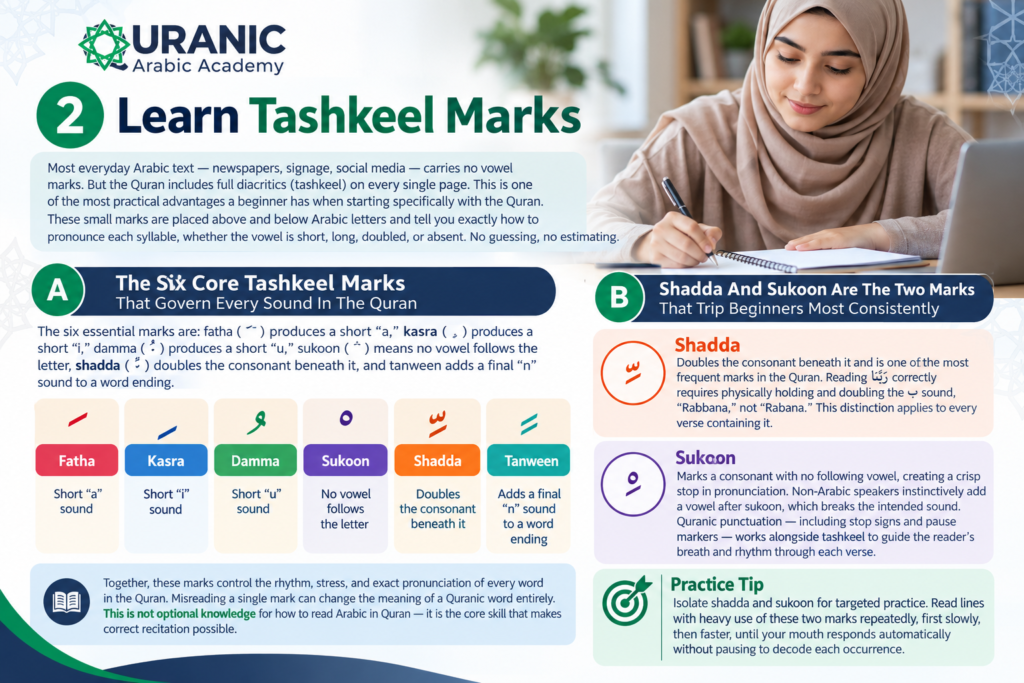
Most everyday Arabic text, newspapers, signage, social media, carries no vowel marks. But the Quran includes full Quranic Arabic diacritics on every single page. This is one of the most practical advantages a beginner has when starting specifically with the Quran.
These small marks are placed above and below Arabic letters and tell you exactly how to pronounce each syllable, whether the vowel is short, long, doubled, or absent. No guessing, no estimating.
Learning to read tashkeel fluently is a distinct skill entirely separate from knowing the letters. Treat it as its own dedicated learning phase, not an extension of alphabet practice, and never an afterthought.
A. The Six Core Tashkeel Marks That Govern Every Sound In The Quran
The six essential marks are: fatha (َ) produces a short “a,” kasra (ِ) produces a short “i,” damma (ُ) produces a short “u,” sukoon (ْ) means no vowel follows the letter, shadda (ّ) doubles the consonant beneath it, and tanween adds a final “n” sound to a word ending.
Together, these marks control the rhythm, stress, and exact pronunciation of every word in the Quran. Having Quranic symbols explained at this level of detail is a step most learners underestimate, until they encounter a word they cannot read correctly without the marks.
Misreading a single mark can change the meaning of a Quranic word entirely. This is not optional knowledge for how to read Arabic in Quran, it is the core skill that makes correct recitation possible.
B. Shadda And Sukoon Are The Two Marks That Trip Beginners Most Consistently
Shadda doubles the consonant beneath it and is one of the most frequent marks in the Quran. Reading رَبَّنَا correctly requires physically holding and doubling the ب sound, “Rabbana,” not “Rabana.” This distinction applies to every verse containing it.
Sukoon marks a consonant with no following vowel, creating a crisp stop in pronunciation. Non-Arabic speakers instinctively add a vowel after sukoon, which breaks the intended sound. Quranic punctuation, including stop signs and pause markers, works alongside tashkeel to guide the reader’s breath and rhythm through each verse.
Isolate shadda and sukoon for targeted practice. Read lines with heavy use of these two marks repeatedly, first slowly, then faster, until your mouth responds automatically without pausing to decode each occurrence.
Shots Videos from Our Courses :
Wondering what our interactive sessions look like? Click below to peek inside a live session and watch how our expert instructors make learning Quranic Arabic accessible and engaging.
Ready to Begin Your Quranic Journey?
Start learning with professional instructors through our structured curriculum.
Book Your Free Trial3. Trains Your Ear Through The Listen-And-Follow Method
Most beginner guides jump straight to written rules, but your ear must be trained before your mouth can produce correct sounds. Learning what Quranic recitation actually sounds like, by listening to a certified reciter first, creates the phonological model your voice will later try to match.
The method works like this: play a verse recited by a skilled reciter, follow each word in the Mushaf with your finger, then mimic what you hear, without analyzing any rules yet. This sequence, hear, follow, mimic, is how children in Muslim-majority countries absorb Quranic sounds before formal study begins.
Begin with short, familiar surahs. Juz Amma Quranic studies make an ideal starting point: the surahs are short, widely known, and available in dozens of high-quality recitations from certified reciters worldwide.
Play a recitation by Mishary Al-Afasy or Mahmoud Khalil Al-Husary, both are exceptionally clear for beginners. Use one of the best Quranic apps like Quran.com or Ayat, and follow the text in your printed Mushaf line by line, replaying each verse three times before advancing.
Quranic Arabic Academy offers structured live classes where certified teachers guide students through this exact listen-and-follow approach in real time.
Students from the USA, UK, Germany, Australia, and Southeast Asia have read their first complete surah within weeks using this method. Start your journey with expert guidance built for English-speaking learners at every level.
4. Learn The Four Foundational Tajweed Rules
Tajweed is the science of reciting the Quran with proper pronunciation, exactly as the Prophet Muhammad ﷺ recited and transmitted it. Quranic tajweed rules may look vast at first, but four foundational rules cover the majority of what a beginner encounters in daily Quran reading.
Tajweed is not a stylistic decoration. In Arabic, a single mispronounced letter or misapplied rule can change the intended word entirely. Correct recitation protects meaning as much as it elevates the beauty of recitation.
Learn these two rule categories in this exact order: noon sakinah and tanween first, then madd elongation. Together, they govern most of what you will encounter in the first juz of the Quran.
A. Noon Sakinah And Tanween Rules Appear On Nearly Every Page Of The Quran
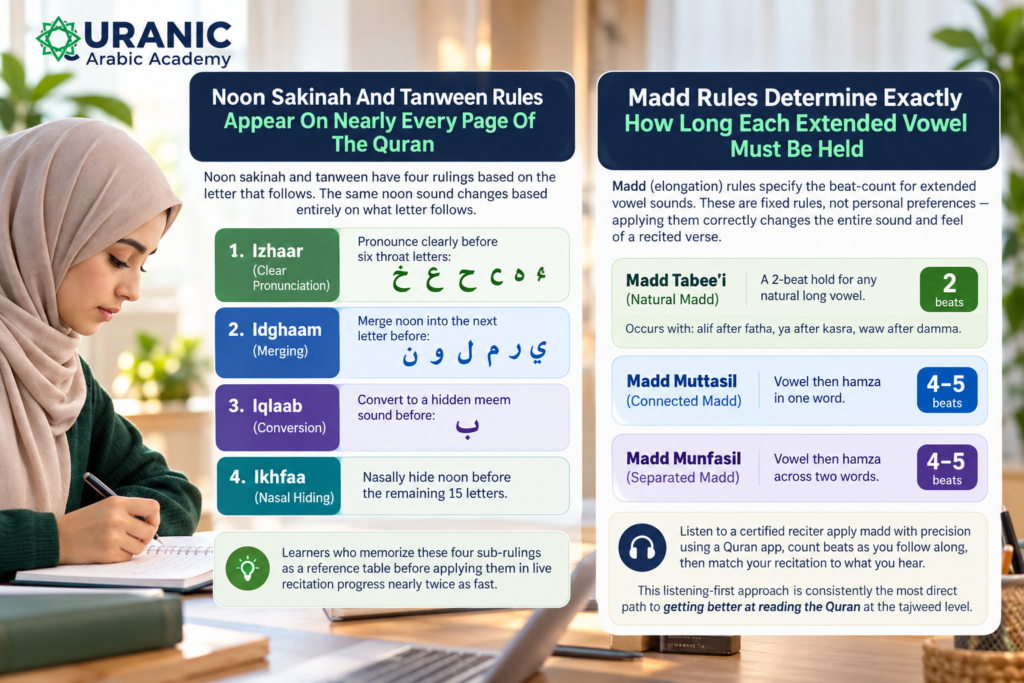
Noon sakinah and tanween have four rulings based on the letter that follows. Izhaar: pronounce clearly before six throat letters (ء ه ع ح غ خ). Idghaam: merge noon into the next letter before (ي ر م ل و ن). Iqlaab: convert to a hidden meem sound before ب only. Ikhfaa: nasally hide noon before the remaining 15 letters.
This rule set governs phonological assimilation across the Quran, a core subject in Quranic linguistics. For the beginner, the practical key is simple: the same noon sound changes based entirely on what letter follows it.
Learners who memorize these four sub-rulings as a reference table before attempting to apply them in live recitation progress nearly twice as fast as those who try to learn and apply simultaneously.
B. Madd Rules Determine Exactly How Long Each Extended Vowel Must Be Held
Madd (elongation) rules specify the beat-count for extended vowel sounds. The foundational rule, madd tabee’i, requires a 2-beat hold for any natural long vowel: alif after fatha, ya after kasra, waw after damma.
Madd muttasil (vowel then hamza in one word) and madd munfasil (vowel then hamza across two words) extend to 4 or 5 beats. These are fixed rules, not personal preferences — applying them correctly changes the entire sound and feel of a recited verse.
Listen to a certified reciter apply madd with precision using a Quran app, count beats as you follow along, then match your recitation to what you hear. This listening-first approach is consistently the most direct path to getting better at reading the Quran at the tajweed level.
5. Use A Color-Coded Mushaf To See Tajweed Rules On Every Line
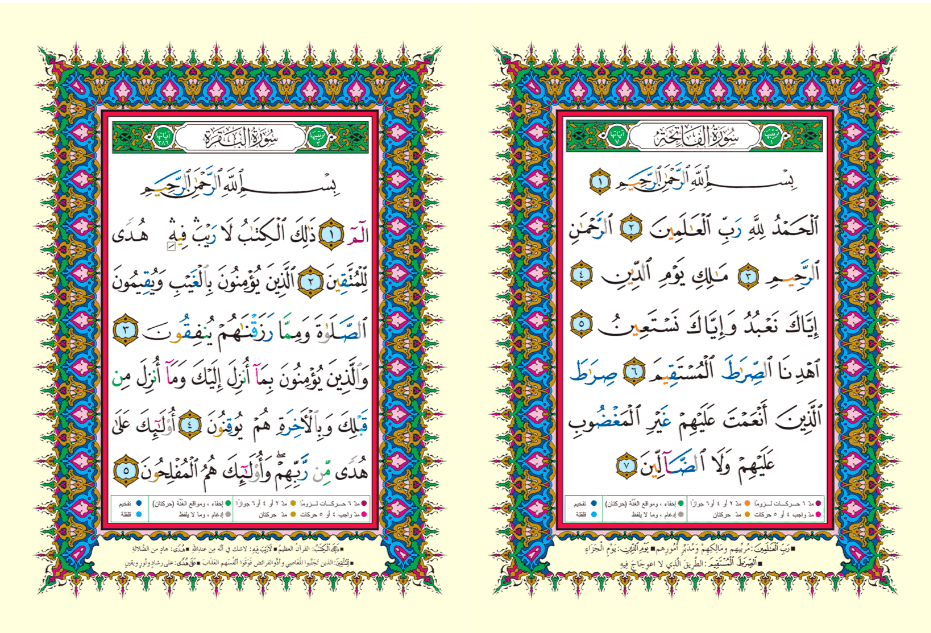
One of the most effective tools for making how to read Arabic Quran easy is the Tajweed Mushaf, a printed Quran where each tajweed rule is marked in a distinct color directly in the Arabic text, on every page, throughout the entire Quran.
Each color corresponds to a specific rule: red marks ghunna (nasalization), green marks madd elongation, blue marks ikhfaa. Pair the Tajweed Mushaf with free Quranic Arabic resources that explain what each color means before you begin reading, the visual system without explanation does very little.
This color-based approach shortens the learning curve significantly. Instead of consciously applying a rulebook to every word, your eye gradually responds to colors automatically, and over weeks, tajweed begins to feel instinctive rather than mechanical.
The Tajweed Mushaf is a tool, not a replacement for instruction. A color you don’t understand does nothing by itself. Use it alongside a teacher or structured course, the visual confirmation in real Quranic text is what makes the rule stick in memory.
6. Master Articulation Points Of Quranic Arabic
Every Arabic letter originates from a precise physical location, a specific point in the mouth, throat, lips, or nasal passage. As covered in depth in this Quranic Arabic: a full expert natives guide, these positions are called makhaarij al-huroof, and they are the most neglected area in beginner Quran education worldwide.
If you produce ح like the “h” in “hello,” or treat ع as a plain vowel sound, you are not reading authentic Arabic, you are producing a reasonable imitation. Makhaarij training corrects this at the physical level, which is the only level where it can actually be corrected.
Most non-Arabic speakers have never produced sounds like ع, غ, خ, or ق in their lives. These sounds don’t exist in English, French, German, or Malay. Supervised, deliberate practice is the only reliable path to producing them correctly.
A. The Five Articulation Zones Form The Complete Map Of Arabic Letter Production
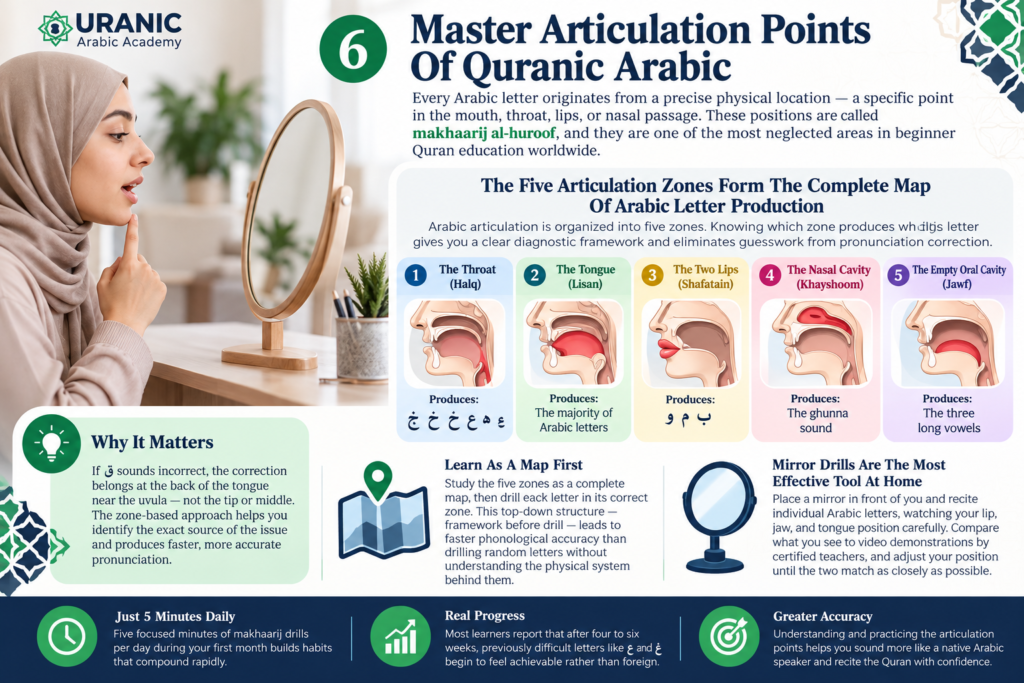
Arabic articulation is organized into five zones: the throat (halq) produces ء ه ع ح غ خ; the tongue (lisan) produces the majority of Arabic letters; the two lips (shafatain) produce ب م و; the nasal cavity (khayshoom) produces the ghunna sound; and the empty oral cavity (jawf) produces the three long vowels.
Knowing which zone produces which letter gives you a diagnostic framework. If ق sounds incorrect, the correction belongs at the back of the tongue near the uvula, not the tip or middle. This zone-based approach eliminates guesswork from pronunciation correction entirely.
Learn the five zones as a map first, then drill each letter in its correct zone. This top-down structure, framework before drill, produces faster phonological accuracy than drilling random letters without understanding the physical system behind them.
B. Mirror Drills Are The Most Effective Tool For Training Articulation At Home
Place a mirror in front of you and recite individual Arabic letters, watching your lip, jaw, and tongue position carefully. Compare what you see to video demonstrations by certified teachers showing the same sound. Adjust your position until the two match as closely as possible.
Articulation drills are a foundational part of understanding how to learn Quranic Arabic correctly at the phonological level. A letter that sounds “close enough” to you may register as clearly wrong to a native Arabic ear, the mirror reveals what self-listening alone cannot.
Five focused minutes of makhaarij drills per day during your first month builds habits that compound rapidly. Most learners report that after four to six weeks, previously impossible letters like ع and غ begin to feel achievable rather than foreign.
Begin Your Quranic Arabic Grammar Journey Today
7. Set A Consistent Daily Routine Of Quran Reading
Most learners don’t fail because of limited ability, they fail because of inconsistency. The benefits of reading the Quran daily extend well beyond spiritual reward: daily exposure to Quranic Arabic builds recognition pathways that irregular, longer sessions simply cannot replicate.
Fifteen minutes every day outperforms two hours once a week. The reason is neurological, consistent, short exposures reinforce letter shapes, sounds, and tajweed patterns more reliably than occasional long sessions. Consistency is the learning mechanism itself.
Designing a routine that fits your real life, not an idealized schedule, is the practical skill that most guides skip entirely. A routine you maintain imperfectly is always more effective than an ambitious one you abandon after ten days.
A. How Consistency Build Quran Reading Skill Faster Than Any Single Method?
Beyond the neurological benefits, consistency compounds spiritually. The rewards of reading the Quran are multiplied for the one who reads it with effort and difficulty, meaning even a slow, effortful beginner earns double reward for the struggle. Daily effort honors that directly.
A learner who reads three lines carefully every day will cover more ground in three months than someone who reads a full page once a week. Daily contact with the Quranic text is the goal, not volume in a single session.
Set a minimum daily target so low you cannot miss it: five minutes, even one line. Once you sit down, most days you will read more than the minimum. The psychology of the lowest-possible commitment is what keeps streaks alive.
B. What Is The Ideal Daily Structure That Work For Busy Adults Worldwide?
Minutes 1–5: Review previously learned material. Read five lines from yesterday’s Mushaf page or a recently completed section. This warm-up reactivates reading pathways before new content arrives and reinforces what you have already built.
Minutes 6–15: Read new content in your Tajweed Mushaf. Set a line target rather than a time target. A daily Quran routine built around three to five careful lines per session produces more lasting retention than rushing through a full page without correction.
Minutes 16–20: Listen to the passage you just read, recited by a certified reciter. Compare your pronunciation to what you hear. Identify one specific point to address in tomorrow’s session, not a list, just one focus. This single-target approach prevents overwhelm and keeps daily improvement sharp.
Quranic Arabic Academy helps students across the USA, UK, Canada, Australia, Germany, France, South Asia, Southeast Asia, and the Gulf build daily reading habits that actually stick. Explore programs built for English-speaking adults and families at every stage of their journey.
Start Building Your Child’s Quranic Arabic Foundation Today

8. Assign A Qualified Teacher To Catch Your Errors
Self-study gets you started, a qualified teacher makes you accurate. Online Quranic studies with certified instructors now make it possible for learners anywhere in the world to receive the real-time, personalized correction that only an expert teacher provides.
You cannot hear your own mispronunciations the way a trained teacher hears them. You cannot see your own articulation errors while simultaneously reading text. These blind spots only resolve through consistent external correction, which is why self-taught learners often carry the same errors for years.
The Prophet Muhammad ﷺ received the Quran verbally from Jibreel and transmitted it verbally to his Companions. The oral transmission chain is not ancient history, it is the method. And the method requires a qualified human teacher.
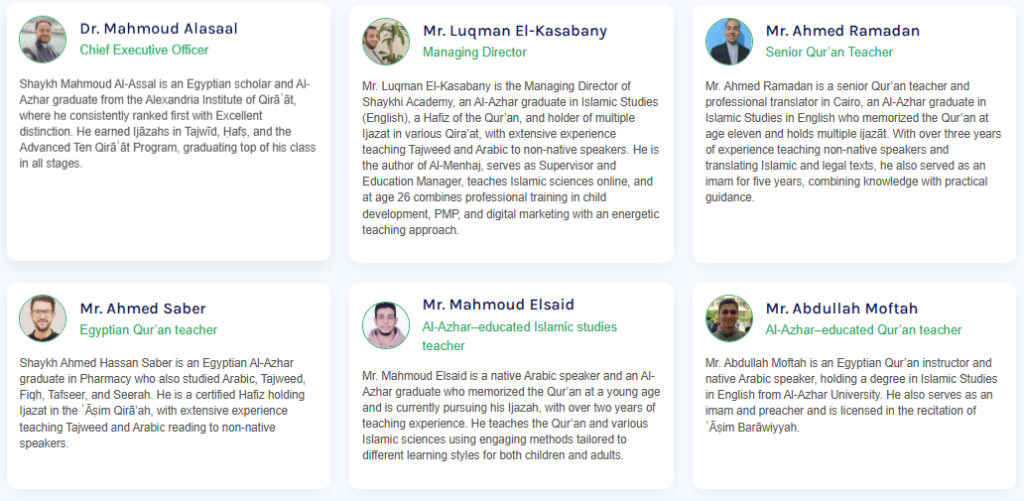
Meet our Dedicated & Experienced Arabic and Quran Teachers.
A. What Does Qualify A Teacher To Correct Your Quranic Recitation Correctly?
The gold standard of Quran teaching qualification is an ijazah, a formal permission to teach recitation, with a named chain of transmitters traced back to the Prophet ﷺ through documented scholars.
This chain is what makes Quranic recitation the most carefully preserved oral tradition in history.
A qualified teacher corrects errors in real time, explains the rule behind each correction, and adjusts pace to the individual student. While Quranic learning with peers builds motivation, a one-on-one certified teacher remains essential for catching the individual pronunciation errors that group settings consistently miss.
Ask any potential teacher directly: “What is your ijazah chain?” A qualified teacher answers specifically and confidently. An unqualified one deflects, generalizes, or changes the subject.
B. How To Find A Certified Quran Teacher From Anywhere In The World Today?
The barrier of geography no longer applies to Quran education. Certified teachers in Egypt, Saudi Arabia, Pakistan, and Malaysia now deliver live one-on-one sessions to students in the USA, UK, Canada, France, and Australia via video call, with full tajweed correction in real time, exactly as in-person instruction delivers it.
When choosing an online platform or teacher, knowing how to create a safe and private online environment for Quranic studies protects both student and teacher. Verified platforms, session recording policies, and reputable academies with clear credential verification are non-negotiable standards for families and individuals learning online.
Begin with a trial session at any academy you consider. Watch how the teacher handles a pronunciation error: do they explain the rule, demonstrate the correct sound, and ask you to repeat? That three-step correction cycle, explain, demonstrate, repeat, is what qualified Quran instruction looks like in practice.
Our Students Reviews:
We believe in clarity and engagement. Watch these short highlights from our actual classes to see our teachers’ methodology and student interactions in real-time.
Ready to Begin Your Quranic Journey?
Start learning with professional instructors through our structured curriculum.
Book Your Free TrialBegin Your Quran Reading Journey With Quranic Arabic Academy Today
You now have a complete, sequenced system for learn how to read Arabic for Quran practice, from alphabet to articulation, from tashkeel to tajweed, from solo practice to expert correction. The system works because each step builds directly on the one before it.
Quranic Arabic Academy offers structured online courses for English-speaking beginners across the USA, UK, Canada, Australia, Germany, France, Gulf countries, South Asia, and Southeast Asia. Our certified teachers hold authentic ijazah chains and teach through a progressive, beginner-tested curriculum.
Start with one trial session. Discover exactly where your level is. Build from there with a teacher who has guided hundreds of learners from their first letter to confident recitation.
Check out our top courses to start learning Quranic Arabic today:
- Quranic Arabic Course for Beginners
- Online Quranic Arabic Courses for Advanced Learners
- Arabic Courses for Understanding the Quran
- Quranic Arabic Course for Sisters (Female)
- Online Quranic Arabic Classes for Adults
Your first class is completely free. Start Learning Quranic Arabic courses Today.

Conclusion
Learning how to read Arabic Quran is a structured process, not a talent you either have or don’t. Every learner who follows these nine steps in the correct sequence makes measurable, lasting progress. The order is as important as the steps themselves.
Each step serves a specific function: the alphabet gives you the building blocks; tashkeel tells you exactly how to sound every word; the listen-and-follow method trains your ear before your tongue attempts a sound; tajweed makes your recitation correct.
In addition to the colored Mushaf makes rules visible in real text; makhaarij training makes your letter production authentic; a daily routine compounds your progress over weeks; and a qualified teacher locks in accuracy that no amount of self-study can guarantee alone.
Many learners wonder how long it takes to learn Quranic Arabic, the honest answer depends entirely on consistency. Follow this system daily, and within one year you will not recognize how far you have come. Start with the Arabic alphabet today.
Frequently Asked Questions
Can I Learn How To Read Arabic Quran Without Speaking Arabic?
Yes. Reading Quranic Arabic and speaking or understanding Arabic are two entirely separate skills. Millions of Muslims worldwide recite the Quran correctly without speaking Arabic fluently. The Quran’s complete tashkeel system makes pronunciation learnable without any conversational Arabic knowledge.
How Long Does It Take To Read Arabic Quran At A Beginner Level?
Most adult learners with no Arabic background reach a functional beginner reading level within three to six months of daily practice. Fluent recitation with applied tajweed typically takes one to two years, depending on practice frequency and whether the learner works regularly with a qualified teacher.
What Is The Best Starting Point For How To Read Arabic Quran Easy?
Begin with the Noorani Qaida — a structured primer that teaches Arabic letters, vowel marks, and connected reading before you open the Quran directly. Pair it with a qualified teacher from day one. Incorrect habits formed without correction at the beginning are significantly harder to fix later.
Is Learning How To Read Arabic In Quran Possible As An Adult?
Absolutely. Adults learn Quranic Arabic every day, across every continent. Adults bring real advantages: intrinsic motivation, disciplined study habits, and the ability to understand rule-based explanations that children must absorb by repetition alone. Consistency, not age, determines the pace of progress.
Do I Need To Finish All Tajweed Rules Before Starting To Read The Quran?
No, you do not need to master all tajweed rules before reading. The proven sequence is letters first, then tashkeel, then four foundational rules, then full recitation with applied tajweed.
Each stage is added only after the previous one feels stable. Trying to learn everything at once slows progress and discourages most beginners before they ever reach consistent reading.
What Is The Noorani Qaida And Should Every Beginner Use It?
The Noorani Qaida is a structured reading primer for Quranic Arabic, developed by Noor Mohammad Ludhianvi. It teaches Arabic letters, vowel marks, letter-joining rules, and early recitation principles in a proven graduated sequence.
It is widely considered the most reliable starting point for non-Arabic speakers. Most certified Quran teachers recommend it precisely because it builds correct habits from the very first lesson — habits that would otherwise take months to correct later.
Related Articles
Learn Quranic Arabic





Leave a Reply